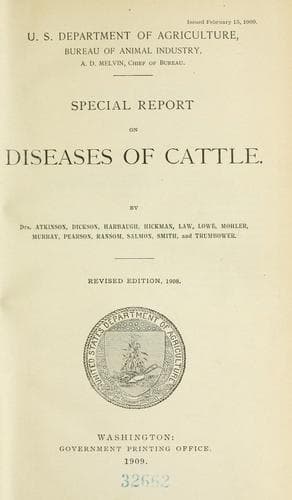
Special report on diseases of cattleUnited States. Bureau of Animal Industry
Science
Special report on diseases of cattle
United States. Bureau of Animal Industry
Cattle -- Diseases
_Modes of union._--The animal should be kept as quiet as possible and given
such feed as will have a tendency to keep the bowels slightly relaxed. The
success of the operation depends chiefly on the skill of the operator, but
not alone in the selection and use of the appliances, for as much attention
must be given to subsequent management. The patients are restless, and a
single awkward motion may undo the work of weeks so far as the union of the
parts of the bone is concerned. Union takes place after the same process
and, if the conditions are favorable, with greater rapidity than in the
human being. The injury that caused the fracture is almost sure to have
extended to some of the adjacent tissues, and even though the fracture may
be of the simplest type there is almost sure to be considerable hemorrhage
around the ends of the broken bone. This, however, is unimportant if the
skin remains intact, unless a very large vessel should be injured, or the
fracture should open some of the important cavities of the body, in which
case a fatal hemorrhage may result. If, on the other hand, the fracture is
compound the external opening furnishes a fertile field for the lodgment of
disease-producing germs.
Unless great care is taken in such cases, a suppurative process is liable
to be established which will seriously interfere with, if not entirely
arrest, the process of union between the bones; or it may become so serious
as to endanger the general health of the animal and even be attended with
fatal results. This last danger is greater if the injury has occurred to
the bones of the arm or thigh. In such cases, owing to the dense covering
of fascia which ensheathes the muscular covering pus is liable to be
imprisoned, and, burrowing downward, saturate the whole structure, not only
endangering the limb, but, by absorption, may set up blood poisoning and
seriously interfere with the general health of the patient, even to causing
death. In order so far as possible to prevent such an unfortunate
complication, the wound should be carefully cleansed with a mild solution
of carbolic acid, then dusted over with iodoform before the bandages are
applied, and cleansed and dressed daily in the same way. After dressing,
always cover with absorbent cotton. In the early process of union an
exudation of lymph takes place, which is at first fluid, gradually becoming
thicker and firmer till it forms a callus, known as the external or
ensheathing callus, in the shape of a ring or ferrule surrounding the
detached portions of the bone. It occasionally happens that this callus
forms only at the ends of the bones, filling the spaces that exist between
them, when it is known as the intermediate callus. The process of union may
be divided into five stages. In the first stage, including the first eight
days, the detached portions of the bone and the sharp projections that are
not sufficiently nourished are absorbed; the blood which escaped into the
Public-domain text, read in full here on John Shaqi.
Reviews
Reviews
No reviews yet
Be the first to share your thoughts on this work.
Elsewhere in the archive
Join the Discussion
Join the discussion
Sign in to leave a comment or review.
Sign InorCreate an account