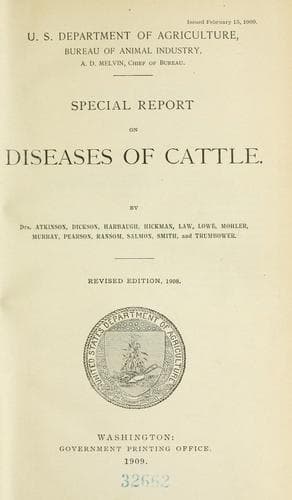
Special report on diseases of cattleUnited States. Bureau of Animal Industry
Science
Special report on diseases of cattle
United States. Bureau of Animal Industry
Cattle -- Diseases
If both the horn and core have been broken off, bleeding is usually severe
and should be checked by astringents, such as alum, or by pressure. After
the hemorrhage has ceased the exposed portion of the fracture should be
covered with pine tar, with or without a bandage. An imperfect growth of
horn will in due time cover the exposed bone.
FRACTURES OF THE BONES OF THE FACE.--These occasionally occur, and when
over the cavities of the nose produce depression, disfigurement, and
impeded respiration, owing to the lessening of the caliber of the nasal
passages.
When such accident occurs, the depressed bone should be gently forced back
to place by introducing the finger in the nostril, or if the fracture is
too far up for this, a probe may be passed and the parts retained by
placing immediately over it a plaster of thin leather or strong canvas
smeared with tar, extending out to the sound surroundings, taking care to
embed the hair over the fractured portion in the tar of the plaster, so
that it will be firmly held and prevented from again becoming depressed. If
only one nostril is involved, the depressed portion may be held in position
by packing that nostril with absorbent cotton. This practice, however, has
the objection of giving the animal great discomfort and in some cases a
disposition to aggravate the injury.
FRACTURE OF THE SKULL (CRANIUM).--Fractures of the bones forming the cavity
in which the brain is situated are, owing to their strength, comparatively
rare among cattle. Such an accident can only be the result of external
violence, and it is hardly possible that it could occur without some
fragment of the broken bone pressing upon the brain so as to cause coma or
other severe nervous derangement, or even death.
If the animal survives the first shock, the efforts should be directed
toward relieving the pressure, which may be done by making an opening in
the bone (trephining), and with a hook drawing the depressed part outward.
Interference is not so liable to be attended with good results as to be
warranted in all cases. The effects of a very severe shock which may not
have produced a fracture, although the symptoms were alarming, will in many
cases pass off, leaving the animal in a better condition than if an
operation had been performed.
FRACTURE OF THE LOWER JAW.--This occasionally occurs, and is more liable to
result from the kick of a horse than from any other cause. The front part
of the jaw may be split or shattered in any direction in which the force
may have been applied. Bloody discharges from the mouth and failure to eat
or ruminate are symptoms most likely to attract attention.
Public-domain text, read in full here on John Shaqi.
Reviews
Reviews
No reviews yet
Be the first to share your thoughts on this work.
Elsewhere in the archive
Join the Discussion
Join the discussion
Sign in to leave a comment or review.
Sign InorCreate an account