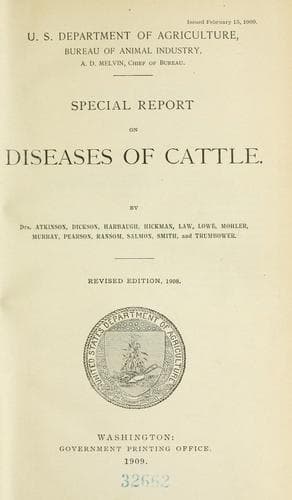
Special report on diseases of cattleUnited States. Bureau of Animal Industry
Science
Special report on diseases of cattle
United States. Bureau of Animal Industry
Cattle -- Diseases
The subject of poisonous plants is an important one and is of especial
interest to those using the western stock ranges, for it is probable that
there is no other single cause producing so many fatalities. In this
article only a few of the more important plants are treated in a brief way,
for an extended treatise would be necessary if the subject were to be
handled adequately. Further information should be sought in the more
elaborate publications. Many of the American poisonous plants have been
treated in bulletins issued by the United States Department of Agriculture.
_Treatment for plant poisoning._--Remedies given by the mouth in most cases
fail to give relief to cattle affected by poisonous plants. The material of
the poisonous plants in the first stomach is not very largely affected by a
remedy given as a drench. If any beneficial result is effected, it must be
on the material which has already passed into the fourth stomach, so that
to get any real antidotal result the remedy must be given repeatedly in
order to meet the alkaloid poisons as they are passing through the fourth
stomach. While certain substances like tannic acid and potassium
permanganate are the logical antidotes for plant poisons, in practical
application they are very disappointing in the treatment of ruminant
animals. Reliance must be mainly on prevention and upon such remedies as
will increase elimination. A laxative or purgative is always helpful, and
for this purpose Epsom salt may be given in pound doses, or linseed oil in
doses of 1 or 2 pints. In some few cases special remedies can be given as
is indicated below.
It is well to bear in mind that cattle while grazing freely in good pasture
are not likely to eat poisonous plants to any extent. If these same plants
are gathered and thrown in a pile, the animals, through a kind of
pernicious curiosity, may eat them with disastrous results. This has
frequently happened when freshly cut branches of cherry, yew, oleander, and
other plants have been thrown where dairy cattle could get at them.
OAKS.
The foliage of oaks is a valuable constituent of the forage on many ranges
and pastures. It has been shown, however, that when this is eaten without
some admixture of other food, cattle frequently sicken and die. Many cases
of the poisoning of cattle by acorns have been reported in England and
Germany, and there have been some complaints in the United States. Harmful
results from eating acorns do not seem likely to occur except as they are
eaten in considerable quantities.
_Symptoms._--The symptoms of oak poisoning are constipation, mucus and
blood in the feces, emaciation, and edema. The symptoms of acorn poisoning
are much the same.
_Treatment._--Change of pasture or an addition of other food material.
HORSE CHESTNUT--BUCKEYE.
Public-domain text, read in full here on John Shaqi.
Reviews
Reviews
No reviews yet
Be the first to share your thoughts on this work.
Elsewhere in the archive
Join the Discussion
Join the discussion
Sign in to leave a comment or review.
Sign InorCreate an account