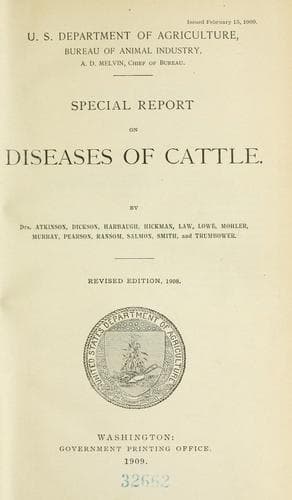
Special report on diseases of cattleUnited States. Bureau of Animal Industry
Science
Special report on diseases of cattle
United States. Bureau of Animal Industry
Cattle -- Diseases
All the species of _∆sculus,_ popularly known as horse chestnut or buckeye,
are considered poisonous. The bark, leaves, and fruit are injurious. It is
said that if the fruit is boiled or roasted and washed out it becomes
harmless and even is a desirable addition to the feed of cattle. The
Indians in time of scarcity of food have used the fruit after preparing it
in this way. The buckeyes are said to have a specific effect in producing
abortion in cattle and goats.
DEATH CAMAS (SPECIES OF ZYGADENUS).
The death-camas plants, which are commonly known in the Pacific States as
"lobelia," are especially destructive of sheep, but cattle sometimes eat
them and are poisoned. Cases of cattle poisoning are not likely to result
fatally.
_Symptoms._--The symptoms are salivation, nausea accompanied by vomiting,
great weakness, and lowered temperature.
_Treatment._--There is no effective treatment for death-camas poisoning.
FLY POISON (CHROSPERMA MUSC∆TORIUM).
This plant, which is closely related to the death-camas plants, is
sometimes known as "stagger grass" and causes a considerable loss in the
Southern States. It grows earlier than the grasses, and on this account is
more likely to be eaten. Like death camas, it produces pronounced nausea,
resulting in vomiting and weakness, and in cases which recover the effects
may continue for several days. Apparently the injurious effects are more
common in the case of cattle than in other domestic animals. There is no
known way of treating these animals, though doubtless purgatives would be
beneficial.
YEW (TAXUS BACCATA).
The European yew has long been known as a very poisonous plant. It is
cultivated in America, and while cases of poisoning have not been common,
it is well to recognize its dangerous character. A comparatively small dose
is poisonous and ordinarily acts with great rapidity. It causes respiratory
paralysis and the animal dies in convulsions.
LAUREL.
The laurels, including the broad-leafed laurel, _Kalmia latifolia_, the
narrow-leafed laurel, _Kalmia angustifolia_, the rhododendrons, and other
closely related plants are poisonous and cause considerable losses. It is
dangerous to let cattle graze where these plants are abundant at times when
other forage is scarce. The symptoms are salivation, nausea and vomiting,
spasms, dizziness, stupor, and death.
FERN.
Public-domain text, read in full here on John Shaqi.
Reviews
Reviews
No reviews yet
Be the first to share your thoughts on this work.
Elsewhere in the archive
Join the Discussion
Join the discussion
Sign in to leave a comment or review.
Sign InorCreate an account