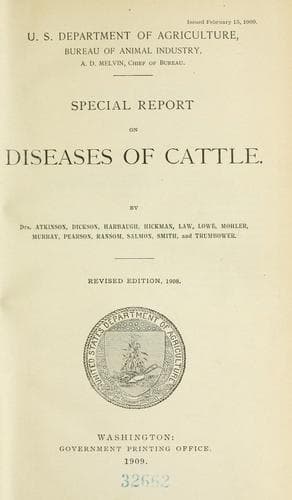
Special report on diseases of cattleUnited States. Bureau of Animal Industry
Science
Special report on diseases of cattle
United States. Bureau of Animal Industry
Cattle -- Diseases
_Treatment._--The treatment is to wash the parts with diluted ammonia or
permanganate of potassium solution and to give stimulants internally. If
there is so much swelling about the head and nostrils as to interfere with
breathing, tracheotomy may be necessary.
POISONING WITH SPANISH FLY.
Spanish fly, in the form of powdered cantharides, may be given in an
overdose, or when applied as a blister to too large a surface of skin
enough may be absorbed to poison. If given by the mouth, it causes severe
irritation of the gastrointestinal tract, shown by salivation, sore throat,
colic, bloody diarrhea, etc. It also produces, whether given by the mouth
or absorbed through the skin, irritation of the urinary tract, as shown by
frequent and painful urination. If death results, it is due to respiratory
paralysis.
_Treatment._--Give protectives and the white of egg, with opium. Do not
give oils or alcohol.
DISEASES OF THE HEART, BLOOD VESSELS, AND
LYMPHATICS.
By W. H. HARBAUGH, V. S.
[Revised by Leonard Pearson, B. S., V. M. D.]
THE CIRCULATORY SYSTEM.
In cattle, as in human beings, the heart, blood vessels, and lymphatics may
be described as the circulatory apparatus.
The heart is in the thoracic cavity (chest). It is conical in form, with
the base or large part uppermost, while the apex, or point, rests just
above the sternum (breastbone). It is situated between the right and left
lungs, the apex inclining to the left, and owing to this the heart beats
are best felt on the left side of the chest, behind the elbow. The heart
may be considered as a hollow muscle, containing four compartments, two on
each side. The upper compartments are called auricles and the lower ones
ventricles. The right auricle and ventricle are completely separated from
the left auricle and ventricle by a thick septum or wall, so that there is
no communication between the right and left sides of the organ.
At the bottom of each auricle is the auriculo-ventricular opening, each
provided with a valve to close it when the heart contracts to force the
blood into the arteries. In the interval between the contractions these
valves hang down into the ventricles.
The muscular tissue of the heart belongs to that class known as
involuntary, because its action is not controlled by the will.
The cavities of the heart are lined by a serous membrane, called the
endocardium, which may be considered as a continuation of the veins and the
arteries, forming their internal lining. The walls of the ventricles are
thicker than those of the auricles, and the walls of the left ventricle are
much thicker than those of the right.
The heart is enveloped by a fibrous sac (or bag), called the pericardium,
which assumes much of the general shape of the outer surface of the heart.
Public-domain text, read in full here on John Shaqi.
Reviews
Reviews
No reviews yet
Be the first to share your thoughts on this work.
Elsewhere in the archive
Join the Discussion
Join the discussion
Sign in to leave a comment or review.
Sign InorCreate an account