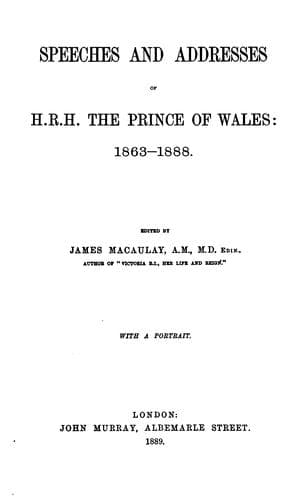
Speeches and Addresses of H. R. H. the Prince of Wales: 1863-1888Edward VII, King of Great Britain
History
Speeches and Addresses of H. R. H. the Prince of Wales: 1863-1888
Edward VII, King of Great Britain
Great Britain -- Politics and government -- 1837-1901
Two boys of each prize school came in succession to the daïs, and
received the prize banners from the Prince's hand. The Prince and his
sons then joined the Princess in her box, and it was a striking scene
when, after some bars of prelude, the words of 'God Bless the Prince of
Wales' were taken up by a thousand young and clear voices, the Prince
and Princess and the two lads standing in the front of the box while it
was sung. The last of the programme was then fulfilled by the bands
playing a selection of music.
The sight altogether was most gratifying. Here were 4000 boys, most of
them paupers, many of them orphans, receiving an excellent education, a
training in physical aptitudes and habits of obedience as well as in
mental studies. The Greenwich School is composed of the children of
seamen being educated for the sea, but the three thousand and more boys
of the other schools must in large part be looked upon as so much
material reclaimed to humanity. In fact, these three thousand and more
boys may, in the words of a paper put forth by the Society of Arts, "be
beheld with confident satisfaction as victims rescued from 'the bad,'
and preserved for the good as honest, self-supporting producers, and
worthy members of the community."
WEYMOUTH AND THE PORTLAND BREAKWATER.
_August 11th, 1872._
On the 11th of August, 1872, the Prince of Wales went from Osborne in
the Royal yacht _Victoria and Albert_, to inaugurate the completed
Breakwater and Harbour of Refuge at Portland, and to pay a visit to
Weymouth, the favourite resort of the Prince's great-grandfather, George
III. A magnificent fleet of ironclads, headed by the _Minotaur_, bearing
the flag of Admiral Hornby, and many other vessels, were in attendance
for the ceremony, of which fifteen were first-rate ironclad ships of
war.
The weather was stormy, and the sea had been too disturbed for the
comfort of the Civil Lords of the Admiralty; but the Prince showed no
signs of suffering from the rough voyage, and manfully went through the
proceedings of the day. The stone being laid, prayers were said by a
clergyman, plaster was spread on the surface on which the last of seven
million tons of Portland stone was to find a firm resting-place, the
usual glass bottle containing newspapers, coins, and a chart of the
island and the breakwater was laid in the groove prepared, and, when the
Prince himself had spread some mortar, the great block was lowered into
its place. His Royal Highness then struck three blows upon it with an
ivory mallet, tested it with a silver level, and completed a very short
but sufficient ceremony, by saying, "I now declare this stone to be well
and truly laid and this great work to be complete." At the concerted
signal of a lowered colour, the guns of the fort began to fire a salute,
and the spectators raised a cheer. The inscription on the stone read as
follows, the concluding quotation having been added, it is stated, by
the Prince himself:--
Public-domain text, read in full here on John Shaqi.
Reviews
Reviews
No reviews yet
Be the first to share your thoughts on this work.
Elsewhere in the archive
Join the Discussion
Join the discussion
Sign in to leave a comment or review.
Sign InorCreate an account