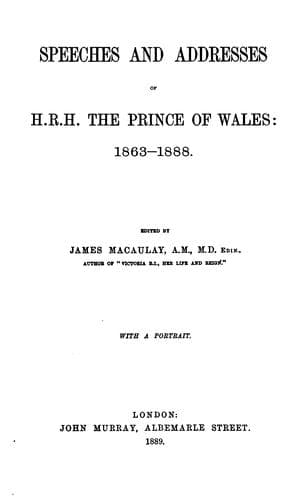
Speeches and Addresses of H. R. H. the Prince of Wales: 1863-1888Edward VII, King of Great Britain
History
Speeches and Addresses of H. R. H. the Prince of Wales: 1863-1888
Edward VII, King of Great Britain
Great Britain -- Politics and government -- 1837-1901
In recent years the subject of intemperance has attracted more
attention, and the crime and poverty resulting from drink has led to a
general consent of opinion that some greater regulation of the trade is
necessary.
UNVEILING ALBERT STATUE AT CAMBRIDGE.
_January 22nd, 1878._
The election of His Royal Highness Prince Albert to the Chancellorship
of the University of Cambridge, was one of the honours of which he was
most justly proud. He was only twenty-eight years of age, and had not
yet been eight years in England. But during these years he had won the
respect and admiration of all that was highest and best in the nation.
When the Chancellorship of Cambridge became vacant by the death of the
Duke of Northumberland, on the 12th of February, 1847, application was
made to the Prince, on the next day, by Dr. Whewell, the Master of
Trinity, to allow himself to be put in nomination for the office. The
request was separately made by the Marquis of Lansdowne on the same day.
A letter from the Bishop of London (Blomfield) conveyed the assurance
that the Prince's acceptance of the office would be regarded by many of
the leading members of the University, with whom he had conferred, as
"honourable and advantageous to the University." The Prince replied,
through Mr. Anson, to whom the bishop's letter was addressed, that he
would be gratified by such a distinction, if it was the unanimous desire
of the University.
Unfortunately there was another candidate proposed, and an election took
place, the Prince obtaining a large majority. Of 24 Professors who
voted, 16 gave their votes for the Prince; of 30 Senior Wranglers, 19
were on his side; while of the resident members 3 to 1 voted for him.
Notwithstanding this strong expression of opinion, the Prince felt
inclined to refuse the office, but was induced to accept it, on the
reasons of the opposition being explained to him, and on the assurance
that the contest would be forgotten after a few months, and that he
might then count on the confidence and goodwill of the whole Academical
body.
Fortunately he accepted, and the assurances of his supporters were more
than verified. On the 24th of March the ceremony of inauguration was
gone through at Buckingham Palace, when the Letters-Patent ware
presented to the Prince by the Vice-Chancellor, accompanied by the most
distinguished officials, and about one hundred and thirty members of the
University. How soon and how powerfully his influence was felt in
advancing education at Cambridge, is matter of history. The following
simple entry in his Diary, on the 1st of November, 1848, shows the
result of his first efforts: "My plan for a reform of the studies at
Cambridge is carried by a large majority." To the enlightened and
judicious plans of the Prince the subsequent advances and extension of
education in England have been largely due. Nowhere was this more
gratefully acknowledged than at Cambridge.
Public-domain text, read in full here on John Shaqi.
Reviews
Reviews
No reviews yet
Be the first to share your thoughts on this work.
Elsewhere in the archive
Join the Discussion
Join the discussion
Sign in to leave a comment or review.
Sign InorCreate an account