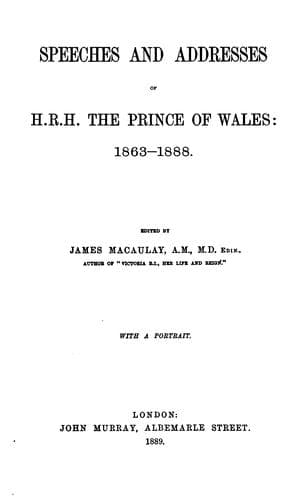
Speeches and Addresses of H. R. H. the Prince of Wales: 1863-1888Edward VII, King of Great Britain
History
Speeches and Addresses of H. R. H. the Prince of Wales: 1863-1888
Edward VII, King of Great Britain
Great Britain -- Politics and government -- 1837-1901
"The representative duties of Royalty in this country are heavier than
the private functions the hardest-worked Englishman has to perform. Only
the other day we were recording the part played by the Prince of Wales
in an ecclesiastical pageant in Cornwall. On Wednesday he was
introducing a foreign Sovereign to the Corporation of London. Straight
from that ceremonial he had to take flight across the island to open
formally the new harbour at Holyhead. In these scenes and a hundred like
them a Prince's functions cannot be discharged satisfactorily unless he
be at once an impersonation of Royal State and, what is harder still,
his own individual self. He must act his public character as if he
enjoyed the festival as much as any of the spectators. He must be able
to stamp a national impress upon the solemnity, yet mark its local and
particular significance. In presenting a King of the Hellenes to the
citizens at the Guildhall the Prince of Wales had to remember that his
guest and the guest of the City was both a near and dear relative and
the embodiment of an illustrious cause. In laying the first stone of a
cathedral at Truro he had to be both Duke of Cornwall and the Heir of
England. In presiding yesterday at Holyhead he had to recollect the
provincial associations connected with the title he bears, and not
forget the imperial importance of a work which creates a new link
between two great divisions of the United Kingdom. That he achieved his
task successfully was a matter of course. No apprehension ever touches
those who are present at a scene of which the Prince of Wales is the
centre, that he may chance to chill by lack of interest, to choose his
words of admiration inopportunely, or to praise without sympathy. The
work he came, as it were, to sanction by national approbation is a grand
engineering undertaking, and is grander yet in its probable moral
consequences. The Prince of Wales understood and expressed its
significance from both aspects."
NEW COLOURS TO THE ROYAL WELSH FUSILIERS.
_August 16th, 1880._
The Royal Welsh Fusiliers (or Twenty-third Regiment of Foot in the old
Army Lists) received the more familiar name from having been first
raised in Wales in 1714, and in honour of the Prince of Wales of that
day. Their nationality is further betokened by the Prince of Wales's
plume, with the motto "Ich Dien," which, together with the Rising Sun,
the Red Dragon, the White Horse, and the Sphinx, they bear on their
colours. The regiment is one of the oldest and most famous in the Army,
and the proud words, "Nec aspera terrent," which are emblazoned on its
regimental silk, it has amply justified by its gallant conduct from the
Battle of the Boyne, in 1690, to the Indian Mutiny, in 1858, including
Egypt, Corunna, Martinique, Albuera, Badajoz, Salamanca, the Pyrenees,
Nivelle, Orthes, Toulouse, Waterloo, Alma, Inkerman, Sebastopol, and
nearly fifty other engagements which are not recorded on its colours.
Public-domain text, read in full here on John Shaqi.
Reviews
Reviews
No reviews yet
Be the first to share your thoughts on this work.
Elsewhere in the archive
Join the Discussion
Join the discussion
Sign in to leave a comment or review.
Sign InorCreate an account