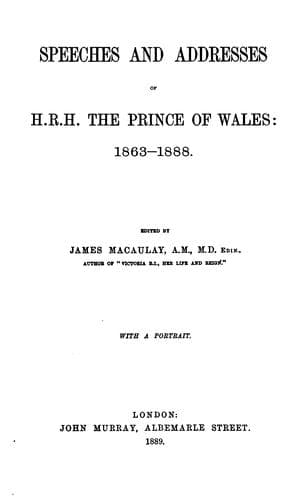
Speeches and Addresses of H. R. H. the Prince of Wales: 1863-1888Edward VII, King of Great Britain
History
Speeches and Addresses of H. R. H. the Prince of Wales: 1863-1888
Edward VII, King of Great Britain
Great Britain -- Politics and government -- 1837-1901
"Now, having taken this glance at the condition of Slavery
to-day, I will add, in the words of the Society, that 'the chief
object of this jubilee meeting is to rekindle the enthusiasm of
England, and to assist her to carry on this civilising torch of
freedom until its beneficent light shall be shed over all the
earth.' The place in which this meeting is held, the character
of this great meeting, and the reception these words have
received, assure me that I have not done wrong in stating freely
these objects. One of the objects of the Society is to circulate
at home and abroad accurate information on the enormities of the
Slave-trade and of Slavery, to give evidence--if evidence,
indeed, be wanting--to the inhabitants of Slave-holding
countries of the pecuniary advantages of free labour, and to
diffuse authentic information respecting the beneficial result
to the countries of emancipation. The late Duke of Gloucester,
in the course of a speech made by him in 1825, said that 'his
family had been brought to this country for the protection of
the rights and liberties of its subjects, and as a member of
that family he should not be discharging his duty towards them
if he did not recommend the sacred principles of freedom by
every means in his power.' Most heartily and most cordially do I
endorse his words.
"I rejoice that we have on the platform the eminent sons of two
eminent fathers in the work of abolishing the Slave-trade and
Slavery. Lord Derby and Mr. Forster, whom I rejoice to see here,
have a hereditary connection with emancipation. The late Lord
Derby, then Mr. Stanley, was Colonial Secretary to the Liberal
Government of that day, which had set before it the task of
carrying through Parliament a measure which was to put a term to
Slavery in all the dependencies of the United Kingdom. Mr.
Forster's father, having taken his full share of the agitation
which led to the abolition of colonial Slavery, went to
Tennessee on an Anti-Slavery errand and died in that State.
There are glimpses, ladies and gentlemen, in Mr. Trevelyan's
'Life of Macaulay,' of the devotion with which this great
movement was carried on. Zachary Macaulay, father of our great
historian, was one of the chief workers in the cause, and it is
said of him that for forty years he was ever burdened with the
thought that he was called upon to wage war with this gigantic
evil. In some of the West India islands the apprenticeship
system produced worse evils than the servitude of the Slave. The
negroes were theoretically free, but practically Slaves. The
masters had been paid for their emancipation, but still held
them to service. In a year or two the term of apprenticeship was
shortened, and soon afterwards public opinion at home demanded
and effected its complete abolition. There were four years of
Public-domain text, read in full here on John Shaqi.
Reviews
Reviews
No reviews yet
Be the first to share your thoughts on this work.
Elsewhere in the archive
Join the Discussion
Join the discussion
Sign in to leave a comment or review.
Sign InorCreate an account