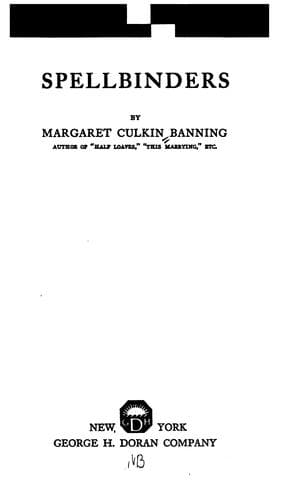
City and town life -- Fiction; Middle West -- Fiction; Spouses -- Fiction; Women -- Political activity -- Fiction
Then came the excitement of the swoop and pause of the Flyer. Freda was
bundled aboard, hat awry, nervously watching for her bag, taken from her
hands by some one, porter or conductor. The curtains swung from all the
berths. The porter’s voice was low and lazy. He showed her to lower
six--a little cubby hole with curtains drawn aside, revealing the
delightful neatness of the berth. Freda knew even less of sleeping on
trains than she did of eating there. Awkwardly she managed to undress
and crept in between the thick white sheets. In the darkness she lay
awake, wondering. Wondering at the rush and sound and the mysteries
shrouded behind green swinging curtains. When the train shrieked a
signal or stopped lurchingly at some station she pushed up the curtain
beside her and, propped on her pillows, lay looking into the night
tasting the full delight of inexperience. At last she fell asleep and
dreamed of Gregory. It was a frightening dream. He did not know who she
was, did not remember her. Towards dawn she pushed her way out of it and
woke up to see the rain falling lightly over the even country and to
realize that she was begrimed with the coal dust and sticky with heat.
At noon she reached Fairmount and stood in the station looking about her
for information. The excitement of the last lap and approaching climax
of her journey overcame her fatigue and her eyes were brilliant. She
decided to take a taxi to the hospital and chose at random one from a
row of disheveled looking “For Hire” machines waiting for the daily
debouch of passengers from the Flyer. She climbed in with her bag and
closed the shaky door, and the driver started his motor. Freda’s heart
was racing. The cab could not go fast enough--nor slow enough. It seemed
to her as if she could not bear what might be waiting of joy or sorrow,
as if emotion was welling up so strong that it would burst its bounds
and overcome her. Through the dusty cab windows she saw Fairmount--ill
developed wooden houses with unhealthy looking trees giving little
shade--a business district of twelve or fifteen squares with all the
machinery of business being conducted as it was at this hour in hundreds
of other First National Banks and Gilt Edge Stores and Greek Restaurants
and brick office buildings. The cab whisked through it rapidly and came
to a section of broader streets where more impressive looking houses of
brick or stone appeared at leisurely intervals. A little park with a
dusty looking playground adjoining it. A row of apartments and there on
the corner where a “Silent Zone” sign, awry and disregarded by a group
of boys playing in the street made a vain appeal, was St. Agatha’s
Hospital.
Inside the little entry was an office with three or four glass windows,
behind which she looked for an informant. A slim, weary looking nun came
at last, looking at her from behind steel rimmed glasses without
curiosity.
“Macmillan--yes,” she said, “you’re--?”
“I’m his wife.”
Public-domain text, read in full here on John Shaqi.
Reviews
Reviews
No reviews yet
Be the first to share your thoughts on this work.
Elsewhere in the archive
Join the Discussion
Join the discussion
Sign in to leave a comment or review.
Sign InorCreate an account