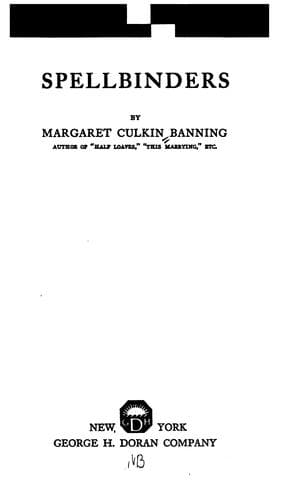
City and town life -- Fiction; Middle West -- Fiction; Spouses -- Fiction; Women -- Political activity -- Fiction
She looked at him out of the corner of her eyes. “You’ll never write a
book about anything, Jerrold. You’re too dilettante to ever get started.
I know. I was the same way until Margaret hurled me into all this
action. Now I am, as you say, spoiled for a good dilettante. I’m spoiled
for a lot of things, in fact. For being an easy going comfortable wife.
I’m a poor wreck of a woman politician.” She laughed at him and looked
so mockingly pretty under the big gray chiffon hat she wore that
Jerrold’s eyes were lit with enthusiasm. Jerrold had motored Helen down
to the Brownleys’ summer home for a conference with Mrs. Brownley, who
had the Junior Republican Club on her hands at the moment and wanted to
talk it over with Helen. Mrs. Brownley had done a great deal of
organizing and much of it was extremely effective along the lines
suggested by Margaret and Mrs. Thorstad. But Mrs. Brownley knew that the
lure of the social column was great and she had pressed Bob and Allie
into action. The Junior Republican Club, composed of girls just
preparing for the vote, was to be one of the educational features of the
campaign. They would be useful, she pointed out, in helping when the
Republican women had headquarters, later--and useful or not they ought
to be interested.
So the Junior Republican Club was formed amid much enthusiasm on the
piazza of the Redding Hotel at Lake Nokomis where St. Pierre sent its
fashionable colony during the summer months. They had a president, and
several news agencies had already taken pictures of them “reading from
left to right and from right to left--standing in the back row, etc.”
One of the agencies had been acting for a New York paper and the girls
were somewhat stirred over the novelty. As Allie said, “It was time some
one did something. Look what happened to Russia where the Bolsheviks
drove you out of your homes and took everything you’d got. If they’d
been organized it might have been different.” Besides her father said he
thought women, especially educated women, (Allie spoke with personal
feeling, having spent four thousand a year at the Elm Grove School) were
to be the salvation of the country.
She had plenty of support and enthusiasm. Even in these spoiled and
under nourished little minds a tiny flame of enthusiasm for the new
possibilities of women’s lives were burning. They interpreted the new
freedom to suit themselves as did most other women. To them it meant a
good deal of license, a cool impudence and camaraderie towards men, a
definite claiming of all the rights of men in so far as they contributed
to the fun of existence. “Women aren’t as they used to be” was a handy
peg for them to hang escapades upon, a blanket reason for refusing to
accept any discipline. That was the substance of their feminism.
Public-domain text, read in full here on John Shaqi.
Reviews
Reviews
No reviews yet
Be the first to share your thoughts on this work.
Elsewhere in the archive
Join the Discussion
Join the discussion
Sign in to leave a comment or review.
Sign InorCreate an account