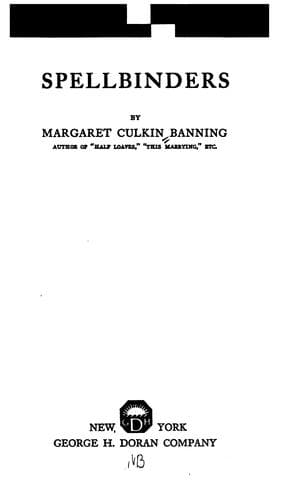
City and town life -- Fiction; Middle West -- Fiction; Spouses -- Fiction; Women -- Political activity -- Fiction
The news had come to the Flandons at breakfast too. Gage had come down
first and picked up the newspaper while he was waiting for Helen and the
children. He read it at a glance and the blow made him a little dizzy.
Like a flood there came over him the quick sense of the utter blackness
of Walter’s mind--more than any sense of loss or pity came horror at the
baffled intellect which had caused the tragedy. He stood, reading,
moistening his lips as Helen entered and lifted the children to their
chairs.
“Any news, Gage?”
He handed it to her silently.
“Oh, my God!” said Helen, “How terrible! How awful, Gage!”
He nodded and sat down in his chair, putting his head in his hands. She
read the article through.
“But why, do you suppose?”
Then she stopped, knowing the thought that must have come to him as it
came to her.
“Poor, poor Walter!”
She went around the table to Gage.
“You’ll go down of course, but take a cup of coffee first,” she said,
her hand on his shoulder.
He roused himself.
“All right.”
Some one telephoned for Gage and he said he would come at once to the
club. They went on with the form of breakfast. The children chattered.
The room shone with sunlight. Helen, through her shock and grief, caught
a glimpse of the shrinking of their trouble against this terrific final
snuffing out of life. Abashed at the comfort it gave her, she drew away
from the thought.
But it made her tender to Gage. It kept persisting, that thought. “It
wasn’t Gage. It might have been Gage. It might have been us. People like
us do go that far then. How horribly selfish this is. Poor Walter!” She
suddenly stopped short. She must telegraph Margaret. Margaret would have
to know. Whatever there had been between her and Carpenter, she must
know. Doubtless--perhaps--she would want to come to see him--Or would
she?
She telegraphed Margaret as compassionately as possible. Yet it seemed a
little absurd to be too compassionate. Margaret wouldn’t like the shock
“broken.” She would want to know the facts.
The sun seemed brighter than it had been for days. Despite the grave
weight of sorrow on her spirit, Helen was calmed, attended by peace.
She was feeling the vast relief attendant on becoming absorbed in a
trouble not her own. It was not that her grief was not deep for
Carpenter. He had been Gage’s good friend and hers. And yet--it was
almost as if in dying he had deflected a tragedy from her, as if he had
bought immunity for her with his terrific price. She dared not tamper
with the thought of what this might do to Gage.
The mail man in his blue coat was coming up the steps. She opened the
door for him, anxious to do something, wondering if there would be a
letter from Margaret. There was. She laid the others aside and read that
first. It was a long letter full of thought, which at another time would
have been interesting. Margaret had wearied of Republicanism. She and
many other women were talking of the “League” again.
Public-domain text, read in full here on John Shaqi.
Reviews
Reviews
No reviews yet
Be the first to share your thoughts on this work.
Elsewhere in the archive
Join the Discussion
Join the discussion
Sign in to leave a comment or review.
Sign InorCreate an account