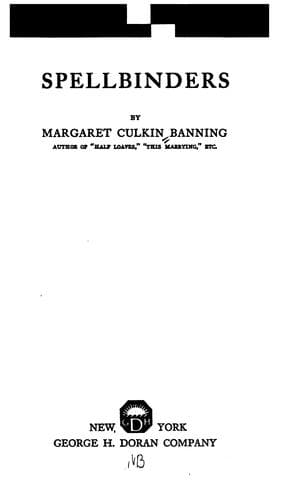
City and town life -- Fiction; Middle West -- Fiction; Spouses -- Fiction; Women -- Political activity -- Fiction
It was a quotation and he did not comment on its content. But he
sketched the lives of some of his poets--his friends--his leaders. He
made their dream clear--their simple idealism--their ignoring of the
politics of expediency--their lives so chaste and beautiful. He told of
their homes, their schools,--and sometimes when he ended simply, “He was
killed in the attack of ----, shot by the military”--or more briefly, “He
was executed on ----,” a shudder ran through his audience.
He would show the gayety of Ireland, the joy of the people, their
exuberance--and end with a simple “Of course it is not like that now.
There is much grief and mourning.”
It was not politics. It was a prose poem composed by a poet. One could
not take exception to it as political but the hearers would forever have
their standpoints colored by what he said. It was like a picture which,
once seen, could never be forgotten.
Margaret listened, her ready mind taking exception to some of the things
he said, seeing how he played upon his audience--Walter and Helen
listened with intellectual appreciation. But Gage, slouched down in his
seat felt envy grow in him. There was before him what he had always
wanted. A man who had something indestructible, something immortal to
care for. A conviction--and an ideal--an outlet for his soul. He felt
himself cheated.
He liked too to listen to the poems about women. No controversial
tirades these poems--but verses soft and sweet and pliable as the
essence of women--once had been. He checked his running thoughts and
looked at his wife, sitting beside him with her head high, “conscious of
herself, every minute now,” he thought bitterly.
CHAPTER XIII
LIFE ENTRUSTED
I
Freda worked until noon the next day. Saturday was a half holiday with
the employees of the firm so there was no question of her remaining in
the office longer. All morning she worked steadily, almost absorbedly.
It was as if she held her ecstasy off from her, unwilling to even think
about it yet.
She had spent the night before, after the lecture to which she went
alone, in writing a letter to her father. It was a long intimate letter,
telling of the kind of work she was doing, the way she was living and of
what she was thinking. She wrote as if she were talking to him, on and
on, and her ending was like the conclusion of a talk, as if she asked
for his blessing. “So you see, father dear, I’m all right. And I want
you to know that I never forget what you’ve said to me--that I must live
so that I’ll never be ashamed of having had life entrusted to me.”
Public-domain text, read in full here on John Shaqi.
Reviews
Reviews
No reviews yet
Be the first to share your thoughts on this work.
Elsewhere in the archive
Join the Discussion
Join the discussion
Sign in to leave a comment or review.
Sign InorCreate an account