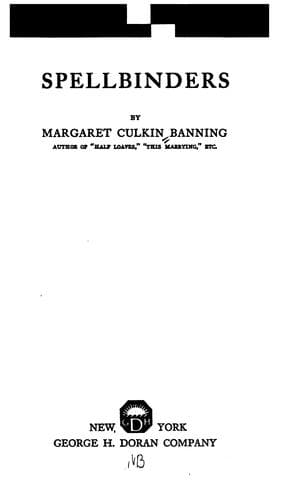
City and town life -- Fiction; Middle West -- Fiction; Spouses -- Fiction; Women -- Political activity -- Fiction
She had to take her thought away from the presence of all these people.
She wanted to con it over--she must get away. Suddenly she stood up and
the heat and distaste for food--the accurate sight of a piece of brown
stringy meat, embedded in lifeless gravy, sickened her. She pressed her
hand before her eyes and swayed a little.
Mrs. Nesbitt jumped up with Cele.
“She’s sick--poor dear. The heat now has quite overcome her.”
They helped her into the least hot of the little bedrooms and she found
herself very sick--nauseated--chilled even while she was conscious of
the heat that oppressed while it did not warm her. The family was all
astir. Mr. Nesbitt underwent censure for having bothered her. But when
Freda, apologetic and recovered, went home on Mike’s arm, getting the
first breath of air which came as a relief to the hot city, Mrs. Nesbitt
came into the room where Cele hung half out of the window trying to
catch the breeze.
“Sick she was, poor thing.”
“Rotten heat got her. She’s not used to working, either, I think. She
felt a lot better. Her stomach got upset too.”
Mrs. Nesbitt pressed her lips together.
“It was a funny way she was taken. If she was a married woman I should
have said the cause was not the heat.”
“Huh?” said Cele, pulling herself in. “What’s that you mean?”
“I mean nothing,” said Mrs. Nesbitt. “Nothing at all. Only I would have
you always be sure to make sure your friends are good girls, my darlin’.
Mind ye, I say nothing against the young lady. But she’s a pretty and
dangerous face and she’s away from her home where by rights should every
girl be.”
CHAPTER XV
THE CONVENTION
I
The Convention gathered. It was an event signal enough to make an
impress even on the great city. Convention Week was recognized by every
one, hotel men, shop keepers, railroad men, newspapers, pickpockets,
police, students in the great universities at the city’s gates, and the
great subordinate multitude which read the newspapers and accepted the
ruling of politics or commerce, as to which days should be held
apart--Labor Day, Mother’s Day, Convention Week.
The streets were hung with banners, great, swinging canvas pieces of
propaganda, bearing crude likenesses of candidates and still cruder
catchwords supposed to represent their opinions or those of their
opinions likely to excite popular pleasure. In the hotel lobbies men
swarmed. Desk clerks, sated with patronage, gave smiling and
condescending negations to those who applied for rooms. The girls at the
cigar counters and newspaper stands worked steadily, throwing back saucy
rejoinders to the occasional impudences of the men.
Public-domain text, read in full here on John Shaqi.
Reviews
Reviews
No reviews yet
Be the first to share your thoughts on this work.
Elsewhere in the archive
Join the Discussion
Join the discussion
Sign in to leave a comment or review.
Sign InorCreate an account