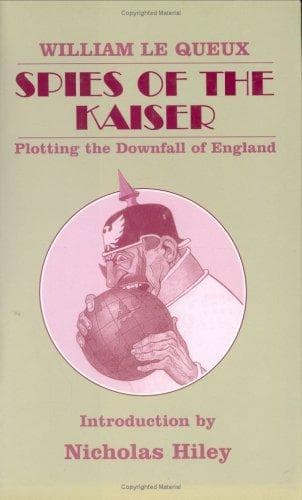
Spies of the Kaiser: Plotting the Downfall of EnglandLe Queux, William
History
Spies of the Kaiser: Plotting the Downfall of England
Le Queux, William
Espionage, German -- Fiction; Great Britain -- History -- Invasions -- Fiction; Intelligence service -- Fiction; Spy stories
I know that the Baron grinned in my face, and that I fell forward
heavily upon the table, my heart gripped in the spasm of death.
Of what occurred afterwards I have no recollection, for, when I slowly
regained knowledge of things around me, I found myself, cramped and
cold, lying beneath a bare, leafless hedge in a grass field. I managed
to struggle to my feet and discovered myself in a bare, flat, open
country. As far as I could judge it was midday.
I got to a gate, skirted a hedge, and gained the main road. With
difficulty I walked to the nearest town, a distance of about four miles,
without meeting a soul, and to my surprise found myself in Hitchin. The
spectacle of a man entering the town in evening dress and hatless in
broad daylight was, no doubt, curious, but I was anxious to return to
London and give information against those who had, without any apparent
motive, laid an ingenious plot to poison me.
At the old Sun Inn, which motorists from London know so well, I learned
that the time was eleven in the morning. The only manner in which I
could account for my presence in Hitchin was that, believed to be dead
by the Baron and his accomplices, I had been conveyed in a motor-car to
the spot where I was found.
A few shillings remained in my pocket, and, strangely enough, beside me
when I recovered consciousness I had found a small fluted phial marked
"Prussic acid--poison." The assassins had attempted to make it apparent
that I had committed suicide!
Two hours later, after a rest and a wash, I borrowed an overcoat and
golf-cap and took the train to King's Cross.
At Judd Street Police Station I made a statement, and with two
plain-clothes officers returned to the house in Burton Crescent, only to
find that the fair Julie and her friends had flown.
On forcing the door, we found the dining-table just as it had been left
after the poisoned snap-dragon of the previous night. Nothing had been
touched. Only Julie, the Baron, the man-servant, and the guests had all
gone, and the place was deserted.
The police were utterly puzzled at the entire absence of motive.
On my return to Guilford Street I at once telephoned to Ray, and he was
quickly with me, Vera accompanying him.
I related the whole of the circumstances, while my friends sat listening
very attentively.
"Well," Ray said at last, "it's a great pity, old chap, you didn't
mention this before. The Baron de Moret is no other person than Lucien
Carron, one of Hartmann's most trusted agents, while Julie's real name
is Erna Hertfeldt, a very clever female spy, who has, of late, been
engaged in endeavouring to obtain certain facts regarding the defences
of the Humber estuary. She was recalled to Berlin recently to consult
Hirsch, chief of the German Intelligence Department. You evidently came
across her on her way back, while the old man whom she met at the Gare
du Nord was Josef Gleichen, the spy whom I told you was in association
with Barker up at Newcastle."
Public-domain text, read in full here on John Shaqi.
Reviews
Reviews
No reviews yet
Be the first to share your thoughts on this work.
Elsewhere in the archive
Join the Discussion
Join the discussion
Sign in to leave a comment or review.
Sign InorCreate an account