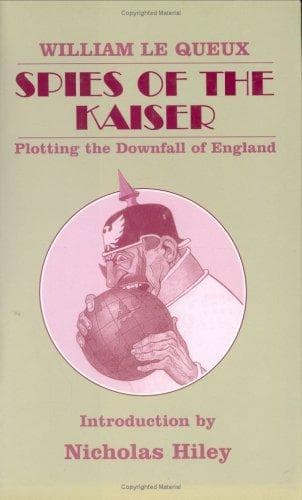
Spies of the Kaiser: Plotting the Downfall of EnglandLe Queux, William
History
Spies of the Kaiser: Plotting the Downfall of England
Le Queux, William
Espionage, German -- Fiction; Great Britain -- History -- Invasions -- Fiction; Intelligence service -- Fiction; Spy stories
The wines which Henry served so quietly and sedately were of the best.
But both my host and myself drank little.
Sandford was telling me of the strange romance concerning his sister
Ellen and young Bingham--a man who had come into eight thousand a year
from his uncle, and only a few days later had met with an accident in
Swindon, having been knocked down by a train at a level-crossing.
Presently, after dessert, our conversation ran upon ports and their
vintages, when suddenly my host remarked:
"I don't know whether you are a connoisseur of brandies, but I happen to
have a couple of rather rare vintages. Let's try them."
I confessed I knew but little about brandies.
"Then I'll teach you how to test them in future," he laughed, adding,
"Henry, bring up those three old cognacs, a bottle of ordinary brandy,
and some liqueur-glasses."
In a few minutes a dozen little glasses made their appearance on a
tray, together with four bottles of brandy, three unlabelled, while the
fourth bore the label of a well-known brand.
"It is not generally known, I think, that one cannot test brandy with
any degree of accuracy by the palate," he said, removing his cigar.
"I wasn't aware of that," I said.
"Well, I'll show you," he went on, and taking four glasses in a row he
poured a little spirit out of each of the bottles into the bottoms of
the glasses. This done, he twisted each glass round in order to wet the
inside with the spirit, and the surplus he emptied into his finger-bowl.
Then, handing me two, he said: "Just hold one in each hand till they're
warm. So."
And taking the remaining two he held one in the hollow of each hand.
For a couple or three minutes we held them thus while he chatted about
the various vintages. Then we placed them in a row.
"Now," he said, "take up each one separately and smell it."
I did so, and found a most pleasant perfume--each, however, quite
separate and distinct, as different as eau-de-Cologne is from lavender
water.
"This," he said, after sniffing at one glass, "is 1815--Waterloo year--a
magnificent vintage. And this," he went on, handing me the second glass,
"is 1829--very excellent, but quite a distinct perfume, you notice. The
third is 1864--also good. Of the 1815 I very fortunately have two
bottles. Bellamy, in Pall Mall, has three bottles, and there are perhaps
four bottles in all Paris. That is all that's left of it. The
fourth--smell it--is the ordinary brandy of commerce."
I did so, but the odour was nauseating after the sweet and distinct
perfume of the other three.
"Just try the 1815," he urged, carefully pouring out about a third of a
glass of the precious pale gold liquid and handing it to me.
I sipped it, finding it exceedingly pleasant to the palate. So old was
it that it seemed to have lost all its strength. It was a really
delicious liqueur--the liqueur of a gourmet, and assuredly a fitting
conclusion to that excellent repast.
Public-domain text, read in full here on John Shaqi.
Reviews
Reviews
No reviews yet
Be the first to share your thoughts on this work.
Elsewhere in the archive
Join the Discussion
Join the discussion
Sign in to leave a comment or review.
Sign InorCreate an account