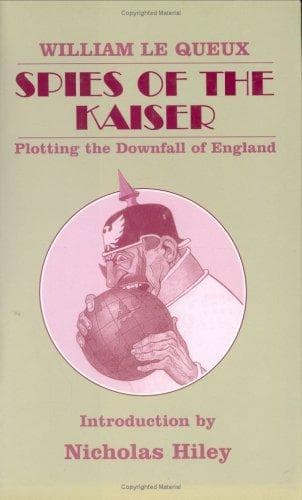
Spies of the Kaiser: Plotting the Downfall of EnglandLe Queux, William
History
Spies of the Kaiser: Plotting the Downfall of England
Le Queux, William
Espionage, German -- Fiction; Great Britain -- History -- Invasions -- Fiction; Intelligence service -- Fiction; Spy stories
And leading me to a stable at the rear of another house about fifty
yards distant, he, aided by Bellamy, broke open the padlocked door.
Within we found great piles of small, strongly bound boxes containing
rifle ammunition, together with about sixty cases of old Martini-Henry
rifles, weapons still very serviceable at close quarters, a quantity of
revolvers, and ten cases of gun-cotton--quite a formidable store of arms
and ammunition, similar to that we found in Essex, and intended, no
doubt, for the arming of the horde of Germans already in London on the
day when the Kaiser gives the signal for the dash upon our shores.
"This is only one of the depôts established in the neighbourhood of the
metropolis," Raymond said. "There are others, and we must set to work to
discover them. Germany leaves nothing to chance, and there are already
in London fifty thousand well-trained men of the Fatherland, most of
whom belong to secret clubs, and who will on 'the Day' rise _en masse_
at the signal of invasion."
"But the Baron!" I exclaimed, half dazed. "Where is he?"
"They've just recovered portions of him," replied Ray, with a grin.
"But that New Year's card!" I exclaimed, and then amid the excitement
proceeded to tell Bellamy and my companion what had happened.
"The message you sent to Manchester was to acquaint Hartmann, who is
staying at this moment at the Midland Grand Hotel, with their intended
vengeance upon you, my dear old chap. Nierop was a Dutch merchant in the
City, and his habit was to import arms and ammunition in small
quantities, and distribute them to the different secret depôts, one of
which we know is somewhere near the 'Adelaide,' in Chalk Farm Road,
another is at a house in Malmesbury Road, Canning Town, a third in
Shepperton Street, Hoxton, and a fourth is said to be close by the
chapel in Cowley Road, Leytonstone."
"And there are others besides," remarked Bellamy.
"Yes," remarked Raymond, "one is certainly somewhere in Crowland Road,
South Tottenham, another near the Gas Works at Hornsey, and others
somewhere between Highgate Hill and the New River reservoir. Besides,
there are no doubt several in such towns as Ipswich, Chelmsford,
Yarmouth, and Norwich."
The police had by this time taken possession of the stable, but no
information was given to the public, fearing that a panic might be
caused if the truth leaked out.
So the newspapers and the public believed the death of the German and
the Dutchman to be due to a gas explosion--at least that was what the
police reported at the inquest. Next day the arms and ammunition were
quietly removed in closed vans from the house and stable which the spies
had rented, and conveyed to safe keeping at Woolwich--where, I believe,
they still remain as evidence of the German intentions.
Public-domain text, read in full here on John Shaqi.
Reviews
Reviews
No reviews yet
Be the first to share your thoughts on this work.
Elsewhere in the archive
Join the Discussion
Join the discussion
Sign in to leave a comment or review.
Sign InorCreate an account