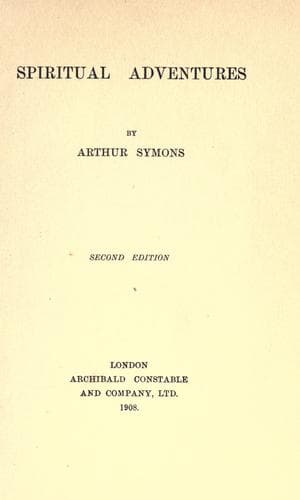
Great Britain -- Social life and customs -- 19th century -- Fiction; Short stories
Meanwhile Livia was deciding that she certainly had made a mistake,
unless she could, after all, succeed in getting her own way; and to do
that she would have to take things into her own hands, much more
positively than she had yet done. She would walk with him when it was
fine, because there was nothing else to do. Once they walked out to the
surprising remains of the abbey of Mont-Major, and it began to rain, and
they lingered uncomfortably about the ruins and in the subterranean
chapel. She walked back with him, nursing a fine hatred in silence. She
turned it over in her heart, and it grew and gathered, like a snowball
rolled over and over in the snow. It was comprehensive and unreasoning,
and it forgot the small grievance out of which it rose, in a sense of
the vast grievance into which it had swollen. To Roserra such moods,
which were now becoming frequent, were unintelligible, and he suffered
from them like one who has to find his way through a camp of his enemies
in the dark.
When they got back to the house, Livia would silently take up a book and
sit motionless for hours, turning over the pages without raising her
eyes, or showing a consciousness of his presence. He pretended to do the
same, but his eyes wandered continually, and he had to read every page
twice over. He wanted to speak, but never knew what to say, when she was
in this prickly state of irritation. To her, his critical way of
waiting, and doing nothing, became an oppression. And his silence, and
what she supposed to be his indifference, grew upon her like a heavy
weight, until the silent woman, who sat there reading sullenly, felt the
impulse to rise and fling away the book, and shriek aloud.
Livia did not say that she wished to go away from Arles, anywhere from
Arles, but the desire spoke in all her silences. She made no complaint,
but Roserra saw an unfriendliness growing up in her eyes which terrified
him. She held him, as she had held him since their first meeting, by a
kind of magnetism which he had come to realise was neither love nor
sympathy. He felt that he could hate her, and yet not free himself from
that influence. What was to be done? He would have to choose; his life
of the future could no longer be his life of the past. His introduction
of a woman to his best friend had been unfortunate, as such
introductions always are, in one way or another. He had tended his soul
for more than half a lifetime, waited upon it delicately, served it with
its favourite food; and now something stronger had come forward and
said: No more. What was it? He had no wish to speculate; it mattered
little whether it was what people called his higher nature, or what they
called his lower nature, which had brought him to this result. At least
he had some recompense.
Public-domain text, read in full here on John Shaqi.
Reviews
Reviews
No reviews yet
Be the first to share your thoughts on this work.
Elsewhere in the archive
Join the Discussion
Join the discussion
Sign in to leave a comment or review.
Sign InorCreate an account