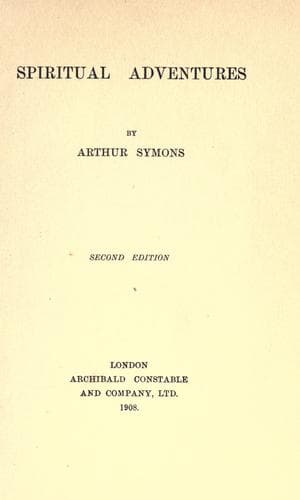
Great Britain -- Social life and customs -- 19th century -- Fiction; Short stories
As he sat there, annihilating thought that he might think the more
deeply, it seemed to him after a time as if all his past life came back
to him under a new aspect, as something which had been wrong from the
beginning. Had he not, as a child, been angry, greedy, loving only his
own pleasure, ungrateful to those who had refused him any of his desires
for his own good? Had he not been heedless and self-willed as a young
man, had he not even made a boast of his own righteousness after he had
found Christ? Was there a day since he had come to a knowledge of good
and evil when he had not sinned at least in thought? He imagined God
adding up all those sins, from the animal sins of childhood to the sins
of the mature mind. 'The Lamb's book of life': he remembered the words,
and they became terrible to him, for he saw all the pages in which his
account was written. For him it would be the book of eternal death.
He lifted his head and looked up. God was up there, beyond that roof
which was his pavement. He was afraid of the great loneliness which lay
between him and God.
He looked around. The drift-net lay out for a mile along the water, its
brown corks heaving gently, at regular intervals. Other boats lay
alongside, with their nets adrift; some of the boats were silent, the
men all asleep; from others he heard voices, a sudden laugh, and then
silence. The water was all about him, and the water was friendly, a
great breathing thing, that had him in its arms. He only felt at home
when he was on the water, because the water was so living, and the land
lay like a dead thing, always the same, but for the change of its
coverings. There was in the Bible one of those hard sayings: that in
heaven 'there shall be no more sea.' It was too difficult for him to
understand.
The sea comforted him a little, but he said to himself: 'I do not want
to be dandled to sleep like a child; I want to see the truth.' Had he,
or had he not, among the numberless sins, which he had seen God adding
up in his book, committed the one sin which should never be pardoned? He
did not know what that sin was, but, he argued, my ignorance makes no
difference. If I pick toad-stools for mushrooms, and eat them, I shall
pay the penalty, just the same as if I had eaten them on purpose. The
Bible, it was true, did not tell you, as far as he could discover; but
there must be people who knew. There was the minister, who had a
reference Bible, and knew Hebrew. He would certainly know.
Public-domain text, read in full here on John Shaqi.
Reviews
Reviews
No reviews yet
Be the first to share your thoughts on this work.
Elsewhere in the archive
Join the Discussion
Join the discussion
Sign in to leave a comment or review.
Sign InorCreate an account