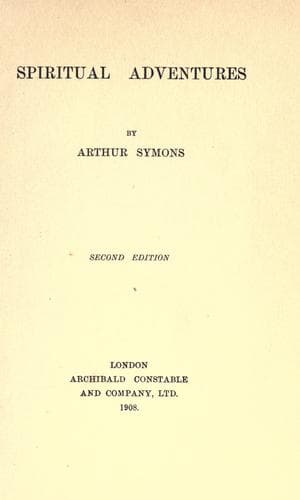
Great Britain -- Social life and customs -- 19th century -- Fiction; Short stories
For my part, I was quite frank with him. I told him it was terrible, to
be alone and to think about death every day of one's life. He put out a
soothing hand professionally, and began to say something about 'with
care' and 'I see no reason why,' and so forth; 'no reason why, with
care, you should not live, well----' 'How long,' I interrupted him, as
he hesitated. 'Thirty years, forty years,' he said confidently, 'why
not? I tell you there is no reason why you should not die an old man.'
And he thought he was comforting me! I only said, 'It is horrible.' 'In
heaven's name,' he said, with real amazement, 'what is horrible?' I told
him: this dwindling away, this continual losing of all the forces that
hold one to life, this inevitable encroachment of the other thing, the
darkness; and the uncertainty of it all, except the ending. 'Come now,'
he said, as if he were arguing with a child, 'be reasonable; you don't
expect to live for ever?' 'That is just it,' I said; and then I put it
to him: 'don't you find it horrible to think of?' 'I never think of it,'
he said. 'I have to see to it every day. One accustoms oneself to the
things one sees every day. You brood over it because it is hidden away
from you.'
He said that as if he was saying something fine, courageous, even
intelligent.
I shivered as he spoke so lightly of seeing people die every day, and I
said, 'You think nothing of it!' 'To me,' he said, more seriously, 'it
is the one quite natural thing in the world. One is tired, one lies
down, one sleeps. And even if one isn't conscious of being tired, there
is nothing so good as sleep.' It struck me that he was quoting from
Marcus Aurelius, in a sort of roundabout way, and I let him go on
talking; but when he looked at me and said: 'I have never met any one
before who worried over the thought that he would have to die when he
was seventy, eighty, ninety: how do you know you won't live to be
ninety?' the simplicity of the man struck me as being laughable; a child
could have reasoned better, and I said: 'If I live to be ninety I shall
never have passed a day without thinking about death, and I know that I
am logically right in never losing sight of the only thing in the world
which is of infinite importance. You call it morbid, but what if only I
am wide awake, after all, and you others are walking straight into a pit
with your eyes shut?' It was then that he repeated that my nerves were
seriously out of order. He told me that I must find distraction. In
other words, I must shut my eyes from time to time. Well, there is no
doubt about it. That is what I must try to do. But how?
* * * * *
Public-domain text, read in full here on John Shaqi.
Reviews
Reviews
No reviews yet
Be the first to share your thoughts on this work.
Elsewhere in the archive
Join the Discussion
Join the discussion
Sign in to leave a comment or review.
Sign InorCreate an account