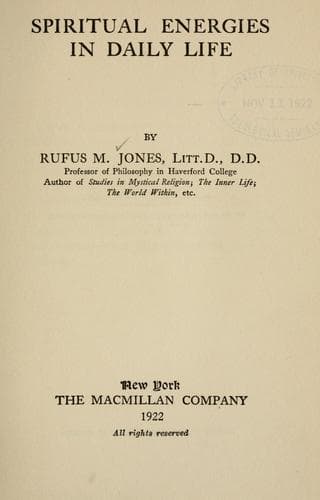
Spiritual Energies in Daily LifeJones, Rufus M. (Rufus Matthew)
Religion
Spiritual Energies in Daily Life
Jones, Rufus M. (Rufus Matthew)
Spiritual life
What, then, is Christianity? In answering this question we can not
confine ourselves to the teaching and the work of Jesus. Important as it
is to go “back to Jesus” that is not enough. We can not fully comprehend
the meaning of Christianity until we take into account the fact that
the invisible, resurrected Christ is the continuation through the ages
of the same revelation begun in the life and teaching of Jesus. Galilee
and Judea mark only one stage of the gospel, which is, in its fullness,
an eternal gospel. The Christian revelation which came to light first
in one Life—its master interpretation and incarnation—has since been
going forward in a continuous and unbroken manifestation of Christ
through many lives and through many groups and through the spiritual
achievements of all those who have lived by him. Christianity is, thus,
the revelation of God through personal life—God humanly revealed. St.
Paul and the writer of the Fourth Gospel were the first to reach this
profound insight into its fuller meaning, though it is plainly suggested
in some of the sayings of Jesus and in the pentecostal experiences of the
first Christians. It is the very heart of the Pauline and the Johannine
Christianity. Important as is the backward look to Jesus in both these
writers, the central emphasis is unmistakably upon the inward experience
of the invisible, spiritual Christ. This is the expectation in the Fourth
Gospel: Greater things than these shall ye do when the Spirit comes upon
you. This is the mystery, the secret of the gospel, St. Paul says, Christ
in you.
If this is the right clew, Christianity is not a new law, nor an
institution, nor a creed, nor a body of doctrine, nor a millennial
hope. It is a type of life, it is a way of living. The most essential
thing about it is the fact of the incursion of God into human life,
the revelation of the eternal in the midst of time, the new discovery
which it brought of God’s nature and character. We nowhere else come so
close to the essential truth of Christianity as we do in the life and
experience of Jesus. The life at every point floods over and transcends
the teaching. He is the most complete and adequate exhibition of what I
have called the incursion of God into human life, but even so he is the
beginning, not the end, of the revelation of God through humanity—the
Christ-revelation of God—and this Christ-revelation of God _is_ God, so
far as he is at all adequately known.
Some persons talk as though God were a kind of composite Being, got by
adding up the God of the natural order, the God of the Old Testament,
and the God as Father about whom Jesus taught. He is, according to this
scheme, in some way a compound aggregate of infinite power, irresistible
justice, and eternal love. Sometimes one “attribute” is predominant,
and sometimes another, while in some mysterious way all the dissonant
attributes get “reconciled.” This is surely boggy ground to build upon.
Public-domain text, read in full here on John Shaqi.
Reviews
Reviews
No reviews yet
Be the first to share your thoughts on this work.
Elsewhere in the archive
Join the Discussion
Join the discussion
Sign in to leave a comment or review.
Sign InorCreate an account