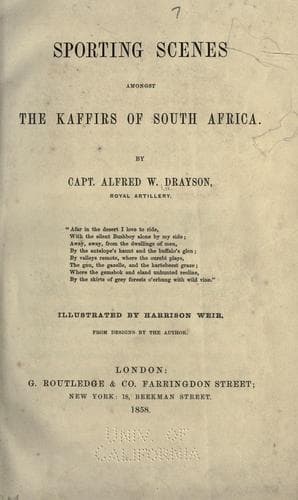
Sporting Scenes amongst the Kaffirs of South AfricaDrayson, Alfred W. (Alfred Wilks)
History
Sporting Scenes amongst the Kaffirs of South Africa
Drayson, Alfred W. (Alfred Wilks)
Hunting -- South Africa; South Africa -- Description and travel
I had given one of these men (Inyovu, my Kaffir servant) my
double-barrelled gun, Monyosi having his own old single-barrelled
musket, while I was armed with a single rifle, carrying a
two-and-a-half-ounce ball.
On arriving at the holes that had contained the water, we found them a
mass of black mud, the surrounding grass being trodden down and daubed
over with it. The trunks of the trees were plastered with mud to the
height of ten or twelve feet, on account of the elephants having enjoyed
a good scrub against them after their wallow.
Monyosi was called upon to state at what time the elephants had rolled
and cleaned themselves at this place. "_Uku sasa namhla_," is at once
decided upon by all of us. There was no doubt about its being "at
daybreak on that day."
The footmarks on the mud had not had a drop of dew on them; those on the
sand under the trees had one or two drops only, that had evidently been
shaken from the branches by the troop in passing. The mud that was on
the stems of the trees was wet, with the exception of some very thin
patches, where the sun had dried it. The leaves that hung on the broken
branches had not yet begun to droop, whilst the fractured limb was still
quite wet from the sap; the grass that had been trodden down was also
fresh and moist; and by these signs we at once knew that at daybreak the
troop of elephants had paid this spot a visit.
Two or three very large circular impressions in the mud indicated the
presence of bulls, while the oval and small ones showed us signs of cow
and calf elephants.
The elephants had wandered about outside the bush for some time; they
had then entered, and walked on in Indian file to the deep and gloomy
recesses of the forest.
The path that the elephants had made was not nearly so large as would be
expected; it would have been impossible to have ridden a horse along it
even a few yards.
We entered on their footsteps, Monyosi leading the spoor; we advanced
with the usual slow, noiseless tread, with occasional rests of five or
ten minutes, for the purpose of listening. This latter performance is
tiresome to the impatient hunter, but most essential.
Listening is the only certain means of discovering the presence of
elephants, as they will frequently stand for hours, in perfect
stillness, especially on a calm hot day, and when the bush affords them
a secure and cool cover.
The rumbling noise in their vast interior they cannot keep quiet: this
sounds like bubbles coming up in water, and is sure to be heard every
five or ten minutes on a still day, even when at a hundred yards'
distance.
We had proceeded about two miles on their traces, and had entered the
densest part of the forest, when we heard this noise, and at once sat
down to listen, to find out all about them.
One's senses become wonderfully acute when much employed at this sort of
work, but still they are far inferior to those of the animals which are
being pursued.
Public-domain text, read in full here on John Shaqi.
Reviews
Reviews
No reviews yet
Be the first to share your thoughts on this work.
Elsewhere in the archive
Join the Discussion
Join the discussion
Sign in to leave a comment or review.
Sign InorCreate an account