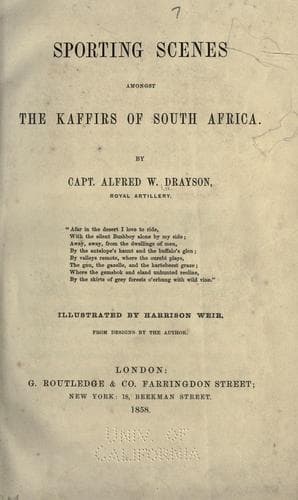
Sporting Scenes amongst the Kaffirs of South AfricaDrayson, Alfred W. (Alfred Wilks)
History
Sporting Scenes amongst the Kaffirs of South Africa
Drayson, Alfred W. (Alfred Wilks)
Hunting -- South Africa; South Africa -- Description and travel
different from ours; they calculate so many elephants' tusks = so much
money, so much money = one cow; six cows = one wife; this being the
highest currency amongst them. It may strike many of my readers (in
case I have them) as odd, that a wife should be valued at such a price.
Their family arrangements, however, are different from ours: whereas our
first expense is generally the least, with them it is the greatest, and
the only one; all that takes place afterwards being interest on their
original investment. If a Kaffir has a large family, especially of
girls, they are soon made useful in the cultivation of his gardens, and,
when at a "coming-out" age, are sold at their fair valuation in cattle.
The honeymoon over, Mrs Matuan, or Eondema, is set to work at once at
turning over the Indian-corn garden, or making baskets to hold milk,
etc. The master of the house, in the mean while, has a look at his
cattle while they are feeding, milks the cows on their return at night,
and then lies in his hut smoking dakka, a very intoxicating root,
something between tobacco and opium. Thus, an investment in wives is a
very common custom amongst rich Kaffirs. I made a great mistake on one
occasion when I intended to give the Kaffir Monyosi a reproof. On going
to his kraal, on a warm beautiful day, to ask him to come out and shoot,
he told me that he was very lazy, and wanted to stay in his hut and
smoke. I told him to come out and shoot, and show himself to be a man,
and not stop in his hut all day like a woman (thinking of our English
customs). He gave a knowing sort of grin, and said, "The _men_ stop in
all day; the _women_ go out and work!" A Kaffir's riches consist in
either wives or cattle, some of the great chiefs having a hundred wives,
and many thousand head of cattle.
Travellers vary in their accounts of the nature of the South-African
savage. Each should speak according to his experience, but at the same
time he should judge fairly, and with all due allowance for the ignorant
state of these people.
Public-domain text, read in full here on John Shaqi.
Reviews
Reviews
No reviews yet
Be the first to share your thoughts on this work.
Elsewhere in the archive
Join the Discussion
Join the discussion
Sign in to leave a comment or review.
Sign InorCreate an account