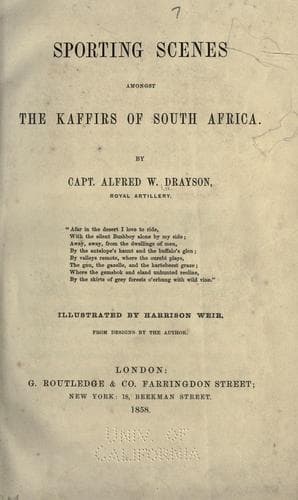
Sporting Scenes amongst the Kaffirs of South AfricaDrayson, Alfred W. (Alfred Wilks)
History
Sporting Scenes amongst the Kaffirs of South Africa
Drayson, Alfred W. (Alfred Wilks)
Hunting -- South Africa; South Africa -- Description and travel
His mode of attack gave me an insight into the method by which this
species of snake destroys animals. The teeth of boa-constrictors being
long, bent, and turned back, something in the fish-hook shape, the
snakes dart out in the manner I have just described, and seize hold of
their prey. Then drawing their heads back again, they pull the animal
to the ground at once, and, coiling round it, commence the crushing
process. This power of squeezing must be enormous. On attempting to
skin this animal, the muscles inside had the appearance of strings of
rope extending from the head to the tail; these he seemed to have the
power of contracting or extending, so that a part that might be three
feet long as he coiled himself round your body, could be instantly
reduced to about a foot, by this means giving any one in his embrace a
very tolerable squeeze. I have before remarked that these snakes are
not considered dangerous to man, as they are not poisonous; and if those
attacked had a sharp knife, and managed to keep their arms free, Mr
Snake would get the worst of it. If one happened, however, to be
asleep, and a boa-constrictor then became familiar, he might so have
wound himself round arms and body as to prevent a knife being used. I
have no doubt that they have power sufficient to crush any man to death
in a very few seconds, did they once get themselves comfortably settled
round his ribs; but I never heard of such a case during my residence at
Natal, although I made every inquiry from the Kaffirs. Formerly there
was a great deal of superstition amongst the Kaffirs with regard to this
snake, and a person who killed one had to go through a quarantine of
purifying; now, however, the Kaffirs do not seem to care much about
them. I saw an old fellow near the Umbilo River pinning a large
boa-constrictor to the ground with several assagies to prevent its
wriggling; he had about a dozen different ones stuck into its body, and
seemed to think a few more would do no harm. He told me that the snake
was a great rascal, and had killed a calf of his some time before; that
he had long watched for an opportunity of catching it out of its hole,
and at last found it so, when a smart race of some yards ended in the
Kaffir assagying the veal-eater.
We tried to skin the boa-constrictor that I had shot, but found great
difficulty in separating the skin from the muscles, and his odour was
strong and disagreeable. Whenever we put in the knife so as to touch
his nerves, he made a little sort of jump that was anything but
pleasant. We contented ourselves, therefore, with a piece of his skin
about six inches long, which remained our only trophy. The colours of
this boa were very brilliant, and they had a bloom on them like a ripe
plum; he was evidently up to good living, for he had breakfasted that
day on a partridge, as was shown by the _post-mortem_. His length was
21 feet, and circumference about 1 foot 6 inches; he must have weighed
about 200 pounds.
Public-domain text, read in full here on John Shaqi.
Reviews
Reviews
No reviews yet
Be the first to share your thoughts on this work.
Elsewhere in the archive
Join the Discussion
Join the discussion
Sign in to leave a comment or review.
Sign InorCreate an account