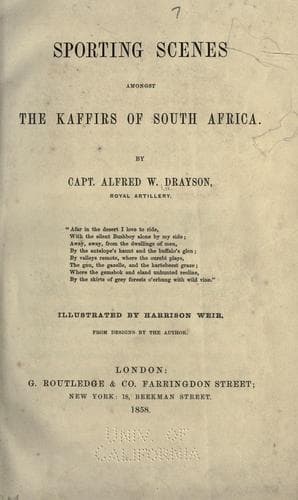
Sporting Scenes amongst the Kaffirs of South AfricaDrayson, Alfred W. (Alfred Wilks)
History
Sporting Scenes amongst the Kaffirs of South Africa
Drayson, Alfred W. (Alfred Wilks)
Hunting -- South Africa; South Africa -- Description and travel
As the night was so brilliant, I determined to push on and try to find
my friend's location, for I was unpleasantly moist, and everything was
so wet that fighting a fire would have been no easy matter. In Africa
we travel by "direction:" "Go out in that direction for two days, and
you will come to my house," is about the amount of information you
frequently get. I knew which way to steer, so pushed straight on in the
hope of seeing some sign of a house. After riding about an hour, I saw
two horsemen going up a hill opposite to me, about half a mile distant;
they were going on slowly, but I could not make them out well, as they
were over the ridge so soon. I galloped on after them, thinking that
they must be some one from my friends, sent out in search of me, but
upon getting on the hill, the horsemen had passed over. I saw them a
few hundred yards in advance, they were looking away from me, and one
was pointing out something to the other. Before I could see well who
they were, my Kaffir came to my side, and exclaimed, _Ma me, ma me!--
bululu bulala!--chingana Bushman_. ("Ma me," is a term of surprise,
"shoot, shoot, rascally Bushman!"). To explain this apparently cruel
proposition, I must state that the Bushmen about here were looked upon
with the most deadly hatred, "every man's hand was against them, and
theirs against every man." They were the farmer's greatest enemies--
wandering from place to place; they had strongholds in the most
inaccessible mountains--active as baboons they retreated to these when
no other place was secure. For days and nights they would watch from
some secret lookout, the cattle or horses of a Boer or Kaffir. Then
having made themselves acquainted with the customs and precautions of
their purposed victims, they at length crept down to the kraal
containing the cattle or horses, took them quietly out early in the
night, and made a rapid retreat before the morning light would enable
the robbed to discover their loss; the Bushmen then being some thirty
miles distant. Pursuit is often impossible, because every horse is
generally taken. Should they be pursued, and see no chance of keeping
the cattle, they will then either hamstring them or stick a poisoned
arrow into them, and thus prevent the farmer from taking advantage of
his speedy pursuit. The Bushman himself being very light, and always
having a good horse, easily gets away. If by chance his horse is shot,
and he reduced to his own legs, he scrambles like a baboon up the rocks
if any are near; if not, he seeks cover behind an ant-hill, or in a
wolf-hole, and prepares his poisoned arrows for defence. Armed with a
quiver full, with five on each side of his head for immediate use, he
cannot be approached with impunity, for at eighty yards the Bushman can
strike a buck while running. Should a man be wounded, then--
Public-domain text, read in full here on John Shaqi.
Reviews
Reviews
No reviews yet
Be the first to share your thoughts on this work.
Elsewhere in the archive
Join the Discussion
Join the discussion
Sign in to leave a comment or review.
Sign InorCreate an account