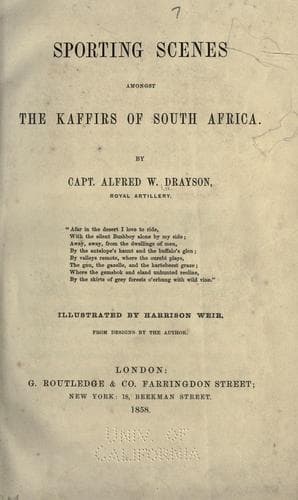
Sporting Scenes amongst the Kaffirs of South AfricaDrayson, Alfred W. (Alfred Wilks)
History
Sporting Scenes amongst the Kaffirs of South Africa
Drayson, Alfred W. (Alfred Wilks)
Hunting -- South Africa; South Africa -- Description and travel
He was used with what he considered great injustice by the government on
the frontier of the colony; appeal after appeal remaining unnoticed. At
last, angry and disgusted, he sold his lands at a great loss, and
started with his wife, children, goods, and cattle to join the emigrant
farmers, who were then settling themselves in the Natal district, at
that time unoccupied by white men. There he thought with the rest that
the laws and regulations of the English would not annoy them, and that
after conquering, with a great sacrifice of life and hard fighting, the
treacherous Zulu chief, Dingaan, they would be allowed to enjoy the
fruits of their victories. Not so, however; a party of English soldiers
shortly came up to Natal, and the officer laid down laws for them all.
_This_ was more than the Dutch could stand. They considered themselves
as an independent colony, and owned no allegiance to Her Majesty. A
fight was the consequence, in which the Boers besieged the English
troops, and were nearly driving them to surrender, when reinforcements
were landed and the Dutch defeated. Most of them "trekked" into the
interior after this, to avoid the English dominion, and amongst them was
the visitor here. He gave me a description of the night attack made by
our troops on the Boers' camp at the Congella, and its disastrous
result, in which about sixteen of our men were killed and thirty
wounded. He stated that, whatever idea our English commander had had,
he never could have surprised the Dutch, as _they_ had Kaffir and
Hottentot spies, who were on the look-out all day and all night; and
before the last ox was inspanned at the guns, the Boers had received
information that the troops were coming to attack them, and had made
their preparations accordingly. The hardships that the troops endured
in the camp, rather than surrender, afford one of the numerous examples
on record of the wonderful gameness and heroism of the English soldier.
Having met with a severe check in the attempted surprise of the Boers'
camp, a little handful of men stood a siege for upwards of a month,
although they were short of provisions, and had but little hope of being
relieved. Had this affair taken place in Europe, each actor in the
scene would have been immortalised for his endurance and gallantry. An
extract from the despatch of the commander will give some idea of the
hardships they underwent:--"Upon inquiring into the state of provisions
this day, I found that only three days' issue of meat remained. I
therefore directed that such horses as were living might be killed, and
made into biltong. We had hitherto been issuing biscuit dust,
alternating with biscuit and rice, at half allowance. The horseflesh,
of which there was but little, we commenced using on the 22nd, and, by a
rigid exactness in the issues, I calculated that we might certainly hold
out, although without meat, for nearly a month longer." The party were
Public-domain text, read in full here on John Shaqi.
Reviews
Reviews
No reviews yet
Be the first to share your thoughts on this work.
Elsewhere in the archive
Join the Discussion
Join the discussion
Sign in to leave a comment or review.
Sign InorCreate an account