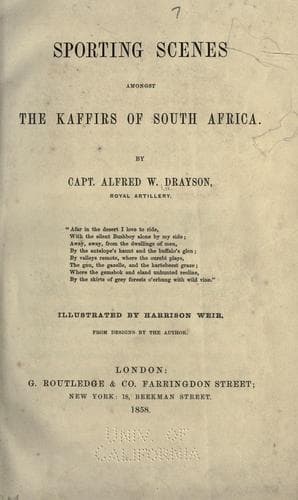
Sporting Scenes amongst the Kaffirs of South AfricaDrayson, Alfred W. (Alfred Wilks)
History
Sporting Scenes amongst the Kaffirs of South Africa
Drayson, Alfred W. (Alfred Wilks)
Hunting -- South Africa; South Africa -- Description and travel
The click which is used, by the Kaffirs need not be attempted by the
beginner in the language,--there are so very few words which require the
click, and these few are quite easily understood without it. The
ambitious linguist frequently renders himself quite unintelligible to a
Kaffir, in consequence of clicking with every word, whether this click
is required or not. It is far better to pronounce distinctly the simple
word, than to attempt to adorn it by a performance which, as I have
before remarked, cannot be perfectly accomplished until the individual
has lost nearly all his teeth.
To any person who may wish to advance in the Kaffir language I submit a
conjugated verb as a model; but I generally found that _ile_, placed at
the end of the infinitive mood, was quite understood by the Kaffirs for
the past tense: as, _uku hamba_, to go; _hambile_, gone; _tanda_, to
love; _tandile_, have loved, etc.
UKUPOZA, TO DRINK.
+
Ý
+
Ý
+
Ý
+
Ý
+
Ý
+
+
Ý
+
Ý
+
Ý
+
Ý
+
Ý
+
+
Ý
+
Ý
+
Ý
+
Ý
+
Ý
+
+
Ý
+
Ý
+
Ý
+
Ý
+
Ý
+
+
Ý
+
Ý
+
Ý
+
Ý
+
Ý
+
+
Ý
+
Ý
+
Ý
+
Ý
+
Ý
+
+
Ý
+
Ý
+
Ý
+
Ý
+
Ý
+
+
Ý
+
Ý
+
Ý
+
Ý
+
Ý
+
Ý
+
Ý
+
Ý
+
Ý
+
A verb receives a prefix corresponding with the first letter or syllable
of its nominative; as, _Poza_, to drink; _Inja ipoza_, the dog drinks.
The adjectives and adverbs undergo the same variations, partaking of the
prefixes of the substantives with which they may be conjoined; the nouns
form diminutives, thus:--
Indoda, a man.
Intombi, a maid.
Indodana, a little man.
Intombazana, a little girl.
Inkozi, a chief.
Inkosana, a young chief, or a little chief.
Di, I.
Wena, you.
Yena, he.
Tina, we.
Zona, they.
Carbo _or_ Hi, no.
Er wer _or_ Tar bo, yes.
Saca bona, a salutation (Good morning).
Hambani gathly or Solaguthly, Good bye.
Uya pina? Where are you going?
On vel api? Where have you come from!
Uku nika, to give.
Uku hamba, to go.
Uku yenza, to do.
Uku zapa, to come.
Uku biza, to call.
Uku poza, to drink.
Uku zisa, to bring.
Uku ejla, to eat.
Uku funa, to want.
Uku bona, to see.
Uku eswa, to hear.
Uku tanda, to like.
Uku sika, to cut.
Uku hlanza, to clean.
Uku landela, to follow.
Uku tenga, to buy.
Uku zingela, to hunt.
Uku sebenza, to work.
Uku kuluma, to talk.
Uku quela, to ride.
Indoda, a man.
Umfazi, a woman.
Injlu, a house.
Amanzi, water.
Umlilo, fire.
Muti, a tree, or medicine.
Injlovu, an elephant.
Imvubu, a hippopotamus.
Inyati or Inthumba, a buffalo.
Impophu, an eland.
Umsiki, a reitbok.
Impenzi, a duiker.
Ihashi, a horse.
Inja, a dog.
Imfena, a baboon.
Inkau, a monkey.
Ingwenie, an alligator.
Inklanzi, a fish.
Inyoni, a bird.
Inyamazan, small game or bucks.
Lenjlela, a road or path.
Namhla, to-day.
Izolo, yesterday.
Goomso, to-morrow.
Goomso futi, to-morrow again, the day after to-morrow.
Futi, again.
Izolo futi, the day before yesterday.
Umlungo, a white man.
Isibum, a gun.
Public-domain text, read in full here on John Shaqi.
Reviews
Reviews
No reviews yet
Be the first to share your thoughts on this work.
Elsewhere in the archive
Join the Discussion
Join the discussion
Sign in to leave a comment or review.
Sign InorCreate an account