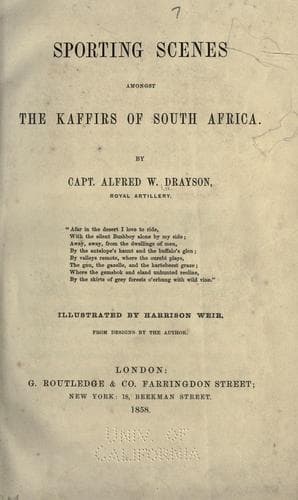
Sporting Scenes amongst the Kaffirs of South AfricaDrayson, Alfred W. (Alfred Wilks)
History
Sporting Scenes amongst the Kaffirs of South Africa
Drayson, Alfred W. (Alfred Wilks)
Hunting -- South Africa; South Africa -- Description and travel
"In this way:--When water gets scarce, I give the Bavian none: if he
does not seem thirsty, I rub a little salt on his tongue; I then take
him out with a long string or chain. At first it was difficult to make
him understand what was wanted, for he always wished to go back to the
waggons. Now, however, he is well-trained.
"When I get him out some distance, I let him go; he runs along a bit,
scratches himself, shows his teeth at me, takes a smell up-wind, looks
all round, picks up a bit of grass, smells or eats it, stands up for
another sniff, canters on, and so on. Wherever the nearest water is,
there he is sure to go." This anecdote was corroborated by others
present.
I think a tame baboon to point water is a new phrase to our
non-travelled sporting friends.
"These elephants must have been very angry," said Kemp. "One never
knows in what temper to find them: they are on one day quiet, and seem
scarcely to object to being shot at, while on another they will not
allow you to come within a quarter of a mile of them without charging
you. I have been very careful how I approached elephants, ever since my
Kaffir was killed by them last year, near the Um Volozie." Another
story was here called for, and Kemp told us the following:--Whilst up
the country shooting, he came on the fresh spoor of a very large
bull-elephant: the traces were quite fresh, the game having passed early
that morning. His Kaffir, who was named Mabili, was a capital shot,
very cool when near large and dangerous game, and brave as a lion. This
man was walking beside the Dutchman, who rode a small pony.
It had been arranged between these two, that Mabili was to be entitled
to half the game if he put the first bullet into the elephant. This was
to give him a greater interest in the hunting, and make him keep a sharp
lookout. If, however, he only assisted at the death of an elephant, he
was to receive whatever the Boer thought that he deserved.
They followed the spoor of the elephant through an open park-like
country, a few scattered bushes and trees being the only cover.
They had proceeded about four miles on the traces, when the elephant was
seen standing under a large tree. I will describe the scene as nearly
in the Dutchman's manner as I can remember:--
Public-domain text, read in full here on John Shaqi.
Reviews
Reviews
No reviews yet
Be the first to share your thoughts on this work.
Elsewhere in the archive
Join the Discussion
Join the discussion
Sign in to leave a comment or review.
Sign InorCreate an account