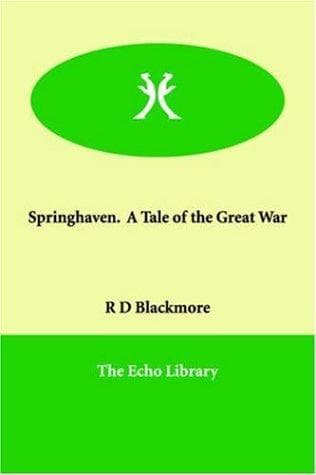
Springhaven: A Tale of the Great WarBlackmore, R. D. (Richard Doddridge)
History
Springhaven: A Tale of the Great War
Blackmore, R. D. (Richard Doddridge)
Great Britain -- History -- Regency, 1800-1837 -- Fiction
Not to moralise about it--for if young ladies hate anything, it is such
moralising--Miss Dolly Darling was now in that uncomfortable frame of
mind when advice is most needed, yet most certain to be spurned. She
looked upon her loving and sensible sister as one who was fated to be
an old maid, and was meant perhaps by nature for that condition, which
appeared to herself the most abject in the world. And even without that
conclusion about Faith she would have been loth to seek counsel from
her, having always resented most unduly what she called her “superior
air of wisdom.” Dolly knew that she was quicker of wit than her
sister--as shallow waters run more rapidly--and she fancied that she
possessed a world of lively feelings into which the slower intellect
could not enter. For instance, their elder brother Frank had just
published a volume of poems, very noble in their way, and glowing with
ardour for freedom, democracy, and the like, as well as exhibiting fine
perception of sound, and great boldness in matters beyond sounding, yet
largely ungifted with knowledge of nature, whether human or superior.
“Better stick to his law-books,” the Admiral had said, after singing out
some of the rhyme of it to the tune of “Billy Benbow”; “never sit on the
wool-sack by spewing oakum this way.”
Faith had tried, as a matter of duty, to peruse this book to its cover;
but she found it beyond even her good-will, and mild sympathy with
everything, to do so. There was not the touch of nature in it which
makes humble people feel, and tickles even the very highest with desire
to enter into it. So Faith declared that it must be very clever, and no
doubt very beautiful, but she herself was so stupid that she could not
make out very clearly what it was all about.
“Well, I understand every word of it,” Miss Dolly cried, with a literary
look. “I don't see how you can help doing that, when you know all about
Frank, who wrote it. Whenever it is not quite clear, it is because he
wants us to think that he knows too much, or else because he is not
quite certain what he wants to mean himself. And as for his talk about
freedom, and all that, I don't see why you should object to it. It is
quite the fashion with all clever people now, and it stops them from
doing any mischief. And nobody pays much attention to them, after the
cruel things done in France when I was seven or eight years old. If I
see Frank, I shall tell him that I like it.”
“And I shall tell him that I don't,” said Faith. “It cannot do anybody
any good. And what they call 'freedom' seems to mean making free with
other people's property.”
Public-domain text, read in full here on John Shaqi.
Reviews
Reviews
No reviews yet
Be the first to share your thoughts on this work.
Elsewhere in the archive
Join the Discussion
Join the discussion
Sign in to leave a comment or review.
Sign InorCreate an account