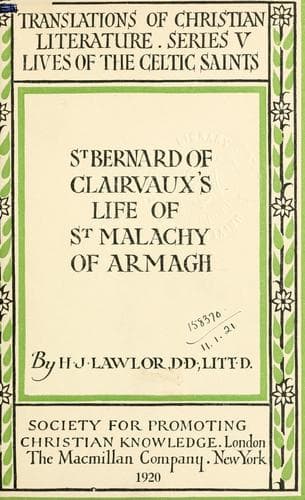
St. Bernard of Clairvaux's Life of St. Malachy of ArmaghBernard, of Clairvaux, Saint
History
St. Bernard of Clairvaux's Life of St. Malachy of Armagh
Bernard, of Clairvaux, Saint
Malachy, Saint, 1094?-1148
As he passed, therefore, through the village called Cruggleton,[570] a
dumb girl met him. While he prayed _the string of her tongue was loosed
and she spake plain_.[571]
Then he entered the village which they call St. Michael's Church,[572]
and before all the people cured a woman who was brought to him, mad and
bound with cords; and when he had sent her away restored he went on.
But when he came to Portus Lapasperi,[573] he waited there for a passage
some days; but the time of delay did not pass idly. In the interval an
oratory is constructed of twigs woven into a hedge, he both giving
directions and himself working. When it was finished he surrounded it
with a wall, and blessed the enclosed space for a cemetery. The merits
of him who blessed, the miracles, which are said to be wrought there
frequently to this day, sufficiently declare.
41. Hence it came that they were in the habit of carrying thither from
the neighbouring places those _that were_ infirm and _diseased_, and
_many_ were healed.[574] A woman paralysed in all her limbs, brought
thither on a waggon, returned home on foot, having waited only one night
in the holy place, not in vain, for the mercy of the Lord.[575]
* * * * *
Let these incidents--a few out of many--suffice with reference to that
place; for now we must proceed with what remains.
FOOTNOTES:
[507] The pall is a sort of collar, made of lamb's wool, which every
metropolitan is required to obtain from the Pope, and without which he
cannot exercise his functions. From the end of the eleventh century it
has been described in papal bulls as the symbol of "the fullness of
the pontifical office" (_Catholic Encyclopedia_, xi. 428). For the
date of Malachy's decision to go to Rome, see p. 72, n. 3.
[508] 1 Sam. xiv. 36, 40 (vg.).
[509] Armagh.
[510] Cashel, the seat of the kings of Munster. It was certainly the
see of an archbishop in 1110, when Malchus subscribed the Acts of
Rathbreasail as archbishop of Cashel. For the date of its foundation
see p. xxxv. f.
Public-domain text, read in full here on John Shaqi.
Reviews
Reviews
No reviews yet
Be the first to share your thoughts on this work.
Elsewhere in the archive
Join the Discussion
Join the discussion
Sign in to leave a comment or review.
Sign InorCreate an account