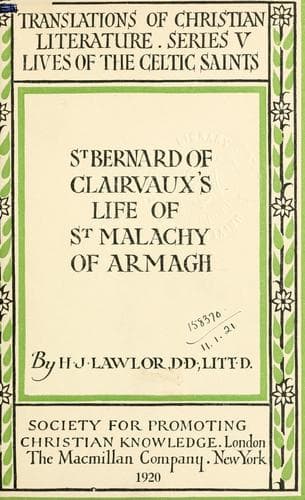
St. Bernard of Clairvaux's Life of St. Malachy of ArmaghBernard, of Clairvaux, Saint
History
St. Bernard of Clairvaux's Life of St. Malachy of Armagh
Bernard, of Clairvaux, Saint
Malachy, Saint, 1094?-1148
[557] Mellifont Abbey, the ruins of which still remain in a secluded
valley, beside the stream known as the Mattock, about two miles from
the Boyne, and five miles west of Drogheda. Some time after Malachy
returned to Ireland he wrote to St. Bernard, asking him to send two of
the four brothers who had been left at Clairvaux to select a site for
the abbey. This request was declined (Lett. i. § 1), and the
site--doubtless the gift of Donough O'Carroll (see the document quoted
p. 170)--was apparently chosen by Malachy himself. In 1142 (_C.M.A._
ii. 262, _Clyn's Annals_, _Annals of Boyle_), the four brothers,
together with a contingent of monks from Clairvaux, arrived, and the
monastery was founded, with Christian as its first abbot (Lett. ii.).
Considerable progress was made with the buildings, and endowments
poured in. But after a while it became necessary to send Christian
back to France for further instruction, and the Clairvaux monks went
with him, never to return. In due time Christian resumed his office as
abbot, and with him came one Robert, to assist him in the work of
building and organization (Lett. iii). The Abbey Church was not
consecrated till 1157, nine years after Malachy's death (_A.U._).
Mellifont remained the principal Cistercian house in Ireland up to the
Reformation. After the dissolution (1539) it was granted, with its
possessions, to Sir Edward Moore, ancestor of the earls of Drogheda.
The only portions of the monastery which remain in a fair state of
preservation are the Chapter House and the Lavabo. The latter belongs
to the original building. Excavations made about twenty years ago
revealed the ground plan of the entire monastery, most of which was of
later date than Malachy. Traces were discovered of the foundation of
the eastern portion of the original church, about forty feet west of
the east wall of the structure which later took its place. It had six
chapels at the east end, four of which were apsidal (_71st Report of
Commissioners of Public Works, Ireland_, p. 11).
[558] 1 Sam. ii. 21.--The five daughters were apparently Bective (de
Beatitudine) founded in 1147, Boyle, 1147-8, Monasternenagh, 1148,
Baltinglas (de Valle Salutis), 1148, and Inislounaght (Janauschek,
_Origines Cistercienses_, Vindoboniæ, 1877, pp. 70, 92, 113). The
last-named seems to have been in existence in 1148 (see § 64), and it
may have been an off-shoot of Mellifont, though at an early date it
was subject to Monasternenagh (_ibid._ 131). Gougaud (_Les Chrétientés
Celtiques_, 1911, p. 364) gives Shrule (de Benedictione Dei) the fifth
place; but it appears to have been founded (1150?) after the _Life_
was written (Janauschek, p. 114).
[559] Cp. Gen. xxii. 17; xxvi. 4.
Public-domain text, read in full here on John Shaqi.
Reviews
Reviews
No reviews yet
Be the first to share your thoughts on this work.
Elsewhere in the archive
Join the Discussion
Join the discussion
Sign in to leave a comment or review.
Sign InorCreate an account