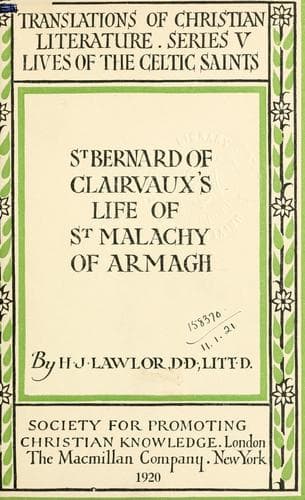
St. Bernard of Clairvaux's Life of St. Malachy of ArmaghBernard, of Clairvaux, Saint
History
St. Bernard of Clairvaux's Life of St. Malachy of Armagh
Bernard, of Clairvaux, Saint
Malachy, Saint, 1094?-1148
43. (24). And in my judgement the first and greatest miracle that he
exhibited was himself.[586] For to say nothing of his _inner man_,[587]
the beauty and strength and purity of which his habits and life
sufficiently attested, he so bore himself even outwardly in a uniform
and consistent manner, and that the most modest and becoming, that
absolutely nothing appeared in him which could offend the beholders.
And, indeed, _he who offends not in word, the same is a perfect
man_.[588] But yet in Malachy, who, though he observed with unusual
care, ever detected, I will not say an _idle word_,[589] but an idle
nod? Who ever knew his hand or his foot to move without purpose? Yea,
what was there that was not edifying in his gait, his mien, his bearing,
his countenance? In fine, neither did sadness darken nor laughter turn
to levity the joyousness of his countenance.[590] Everything in him was
under _discipline_, everything a mark _of virtue_, _a rule_[591] of
perfection. Always he was grave, but not austere. Relaxing at times, but
never careless; neglecting nothing, though for a time ignoring many
things. Quiet often, but by no means at any time idle.[592] From the
first day of his conversion to the last of his life, he lived without
personal possessions.[593] He had neither _menservants_ nor
_maidservants_,[594] nor villages nor hamlets, nor in fact any revenues,
ecclesiastical or secular, even when he was a bishop. There was nothing
whatever ordained or assigned for his episcopal mensa, by which the
bishop might live; for he had not even a house of his own. But he was
almost always going about all the parishes[595] serving the Gospel,[596]
and _living of the Gospel_,[597] as the Lord appointed for him when he
said, _The labourer is worthy of his hire._[598] Except that more
frequently, _making the Gospel_ itself _without charge_,[599] as a
result of the labours of himself and his companions, he brought with
him that by which he might sustain himself and _those who laboured with
him in the work of the ministry_.[600] Further, if at times he had to
rest he did so in the holy places which he himself had scattered through
the whole of Ireland; but he conformed to the customs and observances of
those with whom it pleased him to tarry, content with the common life
and the common table. There was nought in his food, nought in his
clothing, by which Malachy could be distinguished from the rest of the
brethren; to such a degree, though he was _greatest_, did he _humble
himself in all things_.[601]
Public-domain text, read in full here on John Shaqi.
Reviews
Reviews
No reviews yet
Be the first to share your thoughts on this work.
Elsewhere in the archive
Join the Discussion
Join the discussion
Sign in to leave a comment or review.
Sign InorCreate an account