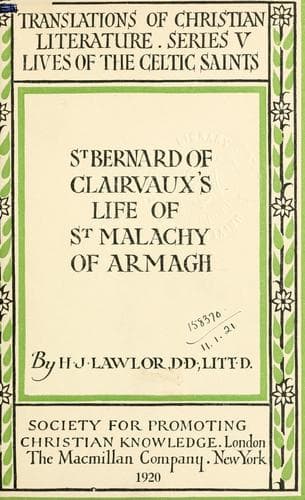
St. Bernard of Clairvaux's Life of St. Malachy of ArmaghBernard, of Clairvaux, Saint
History
St. Bernard of Clairvaux's Life of St. Malachy of Armagh
Bernard, of Clairvaux, Saint
Malachy, Saint, 1094?-1148
[630] In Lecale, co. Down, near Downpatrick. There St. Patrick made
his first convert, and there he died. It is not easy to explain why
St. Bernard calls it a "region." See further, p. 113, n. 3.
[631] Ulaid was a district which included the greater part of the
present county of Down, and the southern part of Antrim.
[632] For a similar avowal by Jocelin, who wrote in the same century
as St. Bernard, and other illustrative passages, see Adamnan, p. 4.
[633] See § 8, and above in this section.
[634] The first of three healings of dumb persons.
[635] Mark vii. 33.
[636] The word "city" implies that there was a religious community at
Antrim. That this was the case is proved by the round tower which
still remains, and other evidence (Reeves, p. 63). But apparently the
_Annals_ do not refer to any monastery or church at that place. See,
however, _U.A._ and _A.F.M._ at 1096 for a possible exception.
[637] 1 Tim. vi. 13.
[638] Ps. lii. 8 (vg.).
[639] Ps. xlv. 7.
[640] Cp. Serm. ii. § 8.
[641] Luke vii. 40.
[642] Acts vi. 5.
[643] Printed text, _Conuama_, no MS. variants being recorded in the
margin: perhaps a misprint for _Clonuama_. Mabillon has _Duevania_ and
K _Duenuania_. A seems to read _Clueuuania_. All these variants point
to _Cluain uama_ (the meadow of the cave), the Irish name for Cloyne,
which is undoubtedly the place referred to (see next note). The next
two miracles are concerned with childbirth. The first of them may have
been related to St. Bernard by Marcus, the author of Tundale's Vision
(see Friedel and Meyer, _La Vision de Tondale_, p. iv., and above p.
lxv. n. 3).
[644] Nehemiah Moriarty, who died in 1149 (_A.F.M._), being then, it
is said, 95 years old (Tundale, p. 5). In Tundale (p. 53 f.) he is one
of four bishops who were with St. Patrick in Paradise, the others
being Cellach, Malachy and Christian O'Morgair. He is there (pp. 5,
54) called bishop of Cloyne (_Cluanensis_).
[645] Cp. 1 Cor. x. 16.
[646] Luke vi. 17.
[647] Mark vi. 18.
[648] 1 Cor. v. 5; 1 Tim. i. 20.
[649] John viii. 4.
[650] Ps. lviii. 10 (vg.).
[651] Probably Dermot MacMurrough, who became king of Leinster in
1126, and died in 1171. He was driven out of his kingdom in 1166, and
then invited the Anglo-Normans to come to his aid. The result was the
conquest of Ireland. His character merits the description which St.
Bernard gives of it.
[652] Rom. xvi. 18.
[653] The first of three healings of paralysis.
[654] John iv. 50.
[655] Gen. ii. 21.
[656] Mark viii. 3.
[657] Acts xiii. 11, etc.
[658] Mark vii. 34.
[659] Cp. Acts xii. 9.
[660] Gen. xlv. 26 (vg.).
[661] Acts iii. 8-10.
[662] Mark vi. 49.
Public-domain text, read in full here on John Shaqi.
Reviews
Reviews
No reviews yet
Be the first to share your thoughts on this work.
Elsewhere in the archive
Join the Discussion
Join the discussion
Sign in to leave a comment or review.
Sign InorCreate an account