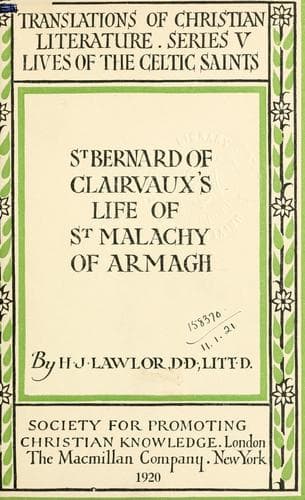
St. Bernard of Clairvaux's Life of St. Malachy of ArmaghBernard, of Clairvaux, Saint
History
St. Bernard of Clairvaux's Life of St. Malachy of Armagh
Bernard, of Clairvaux, Saint
Malachy, Saint, 1094?-1148
[718] _Rem._ This may have been a follower of Berengarius, who in his
recantation in 1059 anathematized the heresy that the bread and wine
"after consecration are merely a sacrament and not the true Body and
Blood of our Lord Jesus Christ" (Mansi, xix. 900).
[719] Compare St. Bernard's method with Abélard, _V.P._ iii. 13;
and for his dealing with a brother who did not believe in
transubstantiation, _ibid._ vii. 8, 9.
[720] I follow the printed text: _de consensu confusus quidem exiit,
sed non correptus_. But Mabillon, supported by A, has "he retired from
the assembly confounded, but not brought to the right opinion" (_de
conuentu ... non correctus_). K reads _de conuentu ... non correptus_.
[721] It would seem from this that Malachy was acting as legate. The
date is therefore after 1140.
[722] Prov. xxviii. 21 (vg.).
[723] John xi. 51.
[724] Isa. xxviii. 19 (vg.).
[725] In §§ 58-62 we have three stories in which Malachy appears as a
peacemaker.
[726] 1 Sam. xvii. 37, combined with 1 Chron. xxii. 16.
[727] Gen. xi. 3 (vg.).
[728] Judg. xvi. 24.
[729] Mark v. 38.
[730] This expression indicates that Malachy had a special relation to
one monastery. It can hardly have been any other than Bangor.
[731] Matt. xi. 17.
[732] 1 Kings xxii. 22; 2 Chron. xviii. 21.
[733] Josh. vi. 21; Judg. iv. 15, etc.
[734] Heb. xi. 8.
[735] Cp. Ps. x. 2.
[736] 1 John iv. 6.
[737] Cp. Mal. i. 6.
[738] Cp. Ps. vii. 16.
[739] Exod. viii. 19.
[740] Hos. ii. 6.
[741] Josh. vii. 15, etc.
[742] In Serm. ii. § 2, where this story is again briefly told, the
miracle is more directly ascribed to Malachy, and the stream is said
to have swelled suddenly.
[743] Cp. Luke iv. 14, etc.
[744] Job v. 13, combined with 1 Cor. iii. 19.
[745] Ps. lxxv. 10.
[746] 1 Sam. ii. 10.
[747] Probably Turlough O'Conor, who is said by the annalists to have
imprisoned illegally several persons of high position, viz. (1) his
own son Rory O'Conor, together with Donnell O'Flaherty and Cathal
O'Conor, in 1143, (2) Murrough Ua Maelsechlainn, king of Meath, in
1143, and (3) Teague O'Brien, in 1148. Release was obtained, in the
first instance, in 1144 by the clergy of Ireland and the "coarb of
Patrick," who fasted at Rathbrennan. The coarb may have been Malachy.
In the second instance, it was secured through the influence of
certain "sureties"; and in the third, "at the intercession of the
bishops of Ireland with the coarb of Patrick, Mael Maedoc Ua Morgair"
(_A.F.M._, _A.T._). The Annals, however, know nothing of the blinding
of O'Conor. The incident in the text is mentioned in Serm. ii. § 2.
[748] Gal iii. 19.
[749] Josh. vii. 15, etc.
[750] Acts xxiii. 14.
[751] An example of the well-known Irish custom of "fasting on" a
person with a view to his discomfiture (cp. p. 106, n. 9).
[752] Ps. lxxi. 4 (inexact quotation).
[753] Exod. viii. 19.
[754] Rev. v. 8.
[755] Isa. xxi. 15 (vg.).
[756] Ps. cxxxix. 7.
[757] Acts xiii. 11.
[758] Acts xxvi. 14.
[759] Ps. cxx. 4.
Public-domain text, read in full here on John Shaqi.
Reviews
Reviews
No reviews yet
Be the first to share your thoughts on this work.
Elsewhere in the archive
Join the Discussion
Join the discussion
Sign in to leave a comment or review.
Sign InorCreate an account