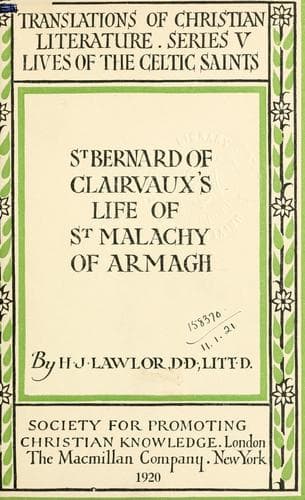
St. Bernard of Clairvaux's Life of St. Malachy of ArmaghBernard, of Clairvaux, Saint
History
St. Bernard of Clairvaux's Life of St. Malachy of Armagh
Bernard, of Clairvaux, Saint
Malachy, Saint, 1094?-1148
[842] The reference is apparently to King Stephen's attempt to prevent
Theobald of Canterbury and other bishops from attending the Council of
Rheims in March 1148. But Malachy does not seem to have been summoned
to the Council, and he did not reach the Channel till long after it
was over (see next note).
[843] Eugenius left Clairvaux on April 27, and Lausanne on May 20
(Jaffé, p. 634). At this rate he might have been expected to reach
Rome by the end of July. About that time, therefore, we may conjecture
that Malachy was on the coast of Kent. Actually, the Pope was not near
Rome till he reached Viterbo on November 30 (_ibid._ 636). St.
Bernard, therefore, when he wrote this passage, was ignorant of his
movements for a considerable time before Malachy's death.
[844] _Oriens_: literally, "east."
[845] Luke i. 78.
[846] Ps. cxviii. 24.
[847] St. Bernard's life-long and ever-increasing frailty is
constantly alluded to by his biographers. It was largely due to his
extreme austerity. In this incident we have an example of the way in
which, on many occasions, the strength of his mind conquered the
weakness of his body (_V. P._ v. 4).
[848] Gen. xxix. 13.
[849] Cant. iii. 4.
[850] Ps. cxxxiii. 1.
[851] Matt. xii. 42; Luke xi. 31.
[852] October 18. Malachy had therefore reached Clairvaux on October
13 or 14. In the interval he met St. Gilbert of Sempringham and
presented him with a pastoral staff (Dugdale, vi. 2, p. xii.). In
France Malachy travelled alone--having been parted from his companions
in England--and probably on horseback (§ 36). He may, therefore, have
left England about September 30, and traversed the 270 miles from
Wissant to Clairvaux by October 14. He apparently intended to start
for Rome on St. Luke's Day (Serm. i. § 1).
[853] That is, in the presence of the community.
[854] Prov. xiv. 13 (inexact quotation).
[855] Luke x. 40.
[856] Cp. 2 Tim. iv. 6, in which the phraseology of the vg. differs
entirely from that of the text.
[857] Not strictly accurate. Malachy reached Clairvaux before his
companions. See p. 123, n. 3.
[858] The physicians said the same (Serm. i. § 2).
[859] This saying is quoted in a slightly different form in Serm. i. §
2.
[860] 2 Tim. iv. 6.
[861] 2 Tim. i. 12.
[862] Ps. lxxviii. 30 (vg.).
[863] Ps. cxxxii. 14 (inexact quotation).
[864] Ps. xvii. 7.
[865] 2 Tim. iv. 8.
[866] All Souls' Day.
[867] For the Cistercian method of administering unction see _Usus
antiquiores ordinis Cisterciensis_, iii. 94 (_P.L._ clxvi. 1471).
[868] _Solario._
[869] Cp. Letter iv. § 2, where it is added that he commended the
Irish brothers to the care of St. Bernard.
[870] _Solio._
[871] Matt. xxiv. 33.
[872] 2 Cor. iii. 7.
[873] Tim. iv. 7.
[874] 2 Sam. i. 23 (inaccurate quotation).--Contrast St. Bernard's
lament for his brother Gerard (_Cant._ xxvi. 4): "We loved in life,
how have we been divided in death? Most bitter separation!"
[875] Ireland.
[876] John xi. 16.
Public-domain text, read in full here on John Shaqi.
Reviews
Reviews
No reviews yet
Be the first to share your thoughts on this work.
Elsewhere in the archive
Join the Discussion
Join the discussion
Sign in to leave a comment or review.
Sign InorCreate an account