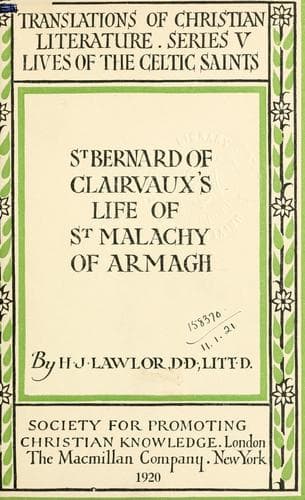
St. Bernard of Clairvaux's Life of St. Malachy of ArmaghBernard, of Clairvaux, Saint
History
St. Bernard of Clairvaux's Life of St. Malachy of Armagh
Bernard, of Clairvaux, Saint
Malachy, Saint, 1094?-1148
3. What things we have heard and known of the wrath of the man and his
vengeance on his enemies, while yet he was _sweet and gentle and
plenteous in mercy unto all_[1133] that suffered need! For he lived for
all as though he were the one parent of all.[1134] _As a hen her
chickens_,[1135] so he cherished all and _protected them under the
covert of his wings_.[1136] He made no distinction of sex or age, of
condition or person;[1137] he failed none, his loving heart embraced
all. In whatsoever affliction men cried to him he counted it his own:
even more than that, for in regard to his own afflictions he was
patient, in regard to those of others he was compassionate, very often
even passionate. For indeed sometimes, filled with wrath, he was stirred
to take the part of one against another, that by _delivering the poor_
and restraining the _strong_[1138] he might take thought in equal
measure for the salvation of all. Therefore he was angry; but it was in
order that he might not sin by not being angry, according to the words
of the Psalm, _Be ye angry and sin not._[1139] Anger did not rule him,
but he himself _ruled his spirit_.[1140] He had power over himself.
Assuredly he who had the victory over himself could not be _mastered by
anger_.[1141] His anger was kept in hand. When it was summoned it came,
going forth, not bursting forth; it was brought into action by his will,
not by impulse. He was not set on fire by it, but used it.[1142] As well
in this as in ruling and restraining all the motions both of his inner
and his outer man[1143] his judgement was careful, his caution great.
For he did not give so much attention to all, as to leave himself alone
out of account, as, in his universal solicitude, to disregard only
himself. He was careful of himself also. He _guarded himself_.[1144] In
fact, he was so wholly his own, so wholly also belonged to all, that his
love seemed in no degree to hinder or delay him from his guardianship of
himself, nor his concern for his own person from the common good.[1145]
If you saw the man busied in the midst of crowds, involved in cares, you
would say he was born for his country, _not for himself_.[1146] If you
saw the man alone and dwelling by himself, you would suppose that he
lived for God alone and for himself.
Public-domain text, read in full here on John Shaqi.
Reviews
Reviews
No reviews yet
Be the first to share your thoughts on this work.
Elsewhere in the archive
Join the Discussion
Join the discussion
Sign in to leave a comment or review.
Sign InorCreate an account