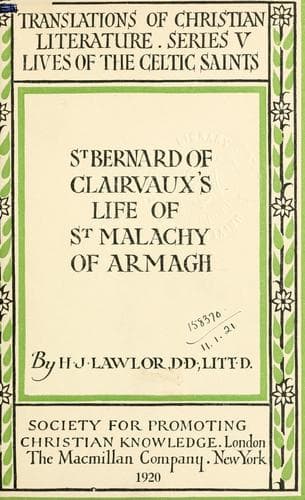
St. Bernard of Clairvaux's Life of St. Malachy of ArmaghBernard, of Clairvaux, Saint
History
St. Bernard of Clairvaux's Life of St. Malachy of Armagh
Bernard, of Clairvaux, Saint
Malachy, Saint, 1094?-1148
But how can this be harmonized with the statement that "fifteen
quasi-generations had passed in this wickedness" (§ 19)? Obviously a
"quasi-generation" is not a generation of human life: apart from the
facts just mentioned, the very word _quasi_ forbids the supposition.
Colgan (_Trias_, p. 301) suggested that the word indicates the period of
office of a coarb; and this is very probable. The figure of generations,
so applied, is in line with St. Bernard's conception of a bishop as "the
seed" of his predecessor (§ 34). But the first of a series of coarbs, of
which Murtough was the fifteenth, was Maelcoba, the second predecessor
of Joseph. So that, even on Colgan's hypothesis, St. Bernard's two
statements are irreconcilable. Yet it is difficult to believe that an
error so manifest was in his source. I suggest that he wrote "fifteen"
in error for "twelve": in other words his document had _xii_, and he
misread it _xu_. The confusion of _u_ with _ii_ is very common in
manuscripts. If this explanation is accepted, St. Bernard's authority
implied that the hereditary succession was upheld without interruption
from the death of Joseph to the accession of Murtough, which is
"well-nigh two hundred years."
This investigation may convince us that St. Bernard depended on an
excellent document for his knowledge of the history of Armagh. But he
certainly went astray in the interpretation of the document when he
styled the predecessors of Cellach metropolitans (see p. 45, n. 1). And
he goes further when he asserts that none were allowed to be bishops who
were not of their family (§ 19); thus leaving the impression that under
the rule of the eight lay abbots--that is, for a century and a
half--Armagh was deprived of episcopal ministrations. But this is wholly
unhistorical. The Ulster Annals mention six bishops of Armagh,
contemporary with the lay abbots. They seem to have followed one another
in regular succession, and there is no indication that any one of them
belonged to the Clann Sinaich. They were no doubt monastic bishops, such
as are found in the Irish Church from the sixth century onwards, who
exercised the functions of their order at the bidding of the abbots.
They were probably not referred to in St. Bernard's document; and if
they were, one who had been trained in an entirely different
ecclesiastical system would have been at a loss to understand their
position.
Thus we conclude that St. Bernard, in the passage which we are
considering, used good material with conscientious care, but that he was
misled by lack of knowledge of Irish ecclesiastical methods. This result
is important because it may apparently be applied to the whole of his
memoir of St. Malachy. His statements, as a rule, stand well the test of
comparison with the native records; and when he is at fault we can
usually explain his errors as misunderstandings, due to ignorance of
conditions of which he had no experience.
Public-domain text, read in full here on John Shaqi.
Reviews
Reviews
No reviews yet
Be the first to share your thoughts on this work.
Elsewhere in the archive
Join the Discussion
Join the discussion
Sign in to leave a comment or review.
Sign InorCreate an account