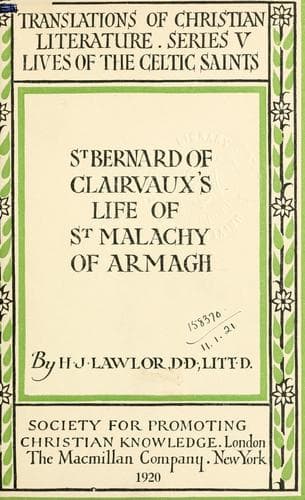
St. Bernard of Clairvaux's Life of St. Malachy of ArmaghBernard, of Clairvaux, Saint
History
St. Bernard of Clairvaux's Life of St. Malachy of Armagh
Bernard, of Clairvaux, Saint
Malachy, Saint, 1094?-1148
O'Carroll, then, was an ardent supporter of Malachy. Is it likely that
after his long struggle to secure the Chair of Patrick, and when he was
in actual possession of it, Malachy should voluntarily surrender his
claim to Niall at the very moment when the new king of Oriel had come to
his aid? Yet, unless we are prepared to place his resignation before
June 1136, that is the assumption we must make if we adhere to the
statements of _A.F.M._
5. There are other documents of high authority which must be taken into
account: the contemporary record of the succession of coarbs of Patrick
in the Book of Leinster, and the copy of a similar record in the Yellow
Book of Lecan. The former of these seems to have been written by a
partizan of Malachy, since it ignores Murtough. The latter assigns to
that abbot a rule of three years, in agreement with St. Bernard (§§ 20,
21). But neither of them so much as mentions Niall; and both make
Gelasius the successor of Malachy. Thus they contradict _A.F.M._ and
corroborate the narrative of St. Bernard. See _R.I.A._ xxxv. 355 f.
FOOTNOTES:
[1201] See Kuno Meyer's Facsimile edition, p. 146, e. The genealogy
there begins with Amalgaid, not with Cellach.
APPENDIX.
The Portion of § 41 of the Life omitted in Translation.
Alia quaedam ibidem _pernoctabat in oratione_,[1202] quam forte
reperiens solam homo barbarus, accensus libidine et sui minime compos,
irruit rabiosus in eam. Conuersa illa et tremefacta, suspiciens aduertit
hominem plenum diabolico spiritu. "Heu," inquit, "miser, quid agis?
Considera ubi es, reuerere haec sancta, defer Deo, defer seruo eius
Malachiæ, parce et tibi ipsi." Non destitit ille, furiis agitatus
iniquis.[1203] Et ecce (quod horribile dictu est) uenenatum et tumidum
animal quod bufonem uocant uisum est reptans exire de inter femora
mulieris. Quid plura? Terrefactus resiliit homo, et datis saltibus
festinus oratorio exsilit. Ille confusus abscessit, et illa intacta
remansit, magno quidem et Dei miraculo et merito Malachiae. Et pulchre
operi foedo et abominando foedum interuenit et abominabile monstrum. Non
prorsus aliter decuit bestialem extingui libidinem quam per
frigidissimum uermem, nec aliter temerarium frenari ausum frustrari
conatum quam per uilem inutilemque bestiolam.
FOOTNOTES:
[1202] Luke vi. 12.
[1203] In hexameter rhythm. Cp. Virg., _Aen._ iii. 331; Ov., _Art.
Am._ ii. 27.
INDEX
Abélard, 101
Acoemetae, 30
Adeline, 69
Age for ordination, 15 f.
Agnew, Sir Andrew, 78
Aidan, St., liv
Ailech, 40
Aleth, mother of St. Bernard, 7, 71
Alexander I., King of Scots, 76
Alps, 72
passes of, when closed, 142
Alternative sees, xlvii, 19
Amalgaid, coarb of Patrick, 164, 165
Anacletus II., anti-pope, 72
Anastasius, St., monastery of, at Rome, 118
_Anmchara_, 161
Anselm, archbishop of Canterbury, xv, xxii, xxiv, xxvi, xxxvi, 47, 162
letters of, xxiv, xxix, xlvi, 47
Antiphonary of Armagh, 170
---- of Bangor, 28
Antrim, 88
Applecross, 29
Arch-priests, xxvii
Public-domain text, read in full here on John Shaqi.
Reviews
Reviews
No reviews yet
Be the first to share your thoughts on this work.
Elsewhere in the archive
Join the Discussion
Join the discussion
Sign in to leave a comment or review.
Sign InorCreate an account