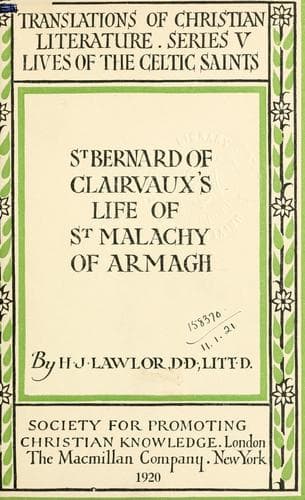
St. Bernard of Clairvaux's Life of St. Malachy of ArmaghBernard, of Clairvaux, Saint
History
St. Bernard of Clairvaux's Life of St. Malachy of Armagh
Bernard, of Clairvaux, Saint
Malachy, Saint, 1094?-1148
[358] This sentence seems to imply that Malachy brought with him the
Bangor community, or the greater part of it, and made a new home for
it in Iveragh. If so the inference is obvious that up to 1127 Malachy
resided at Bangor, and was still abbot.
[359] See §§ 9, 10.
[360] Acts ix. 28 (inexact quotation).
[361] Gen. xxx. 27.
[362] Luke i. 8.
[363] Cp. Luke xii. 37; xxii. 27.
[364] Cp. 1 Cor. xv. 10; 2 Cor. xi. 23.
CHAPTER IV.
_Being made Archbishop of Armagh, he suffers many troubles. Peace being
made, from being Archbishop of Armagh he becomes Bishop of Down._
[Sidenote: 1129]
19. (12). Meanwhile[365] it happened that Archbishop Cellach[366] fell
sick: he it was who ordained Malachy deacon, presbyter and bishop: and
knowing that he was dying he made a sort of testament[367] to the effect
that Malachy ought to succeed him,[368] because none seemed worthier to
be bishop of the first see. This he gave in charge to those who were
present, this he commanded to the absent, this to the two kings of
Munster[369] and to the magnates of the land he specially enjoined by
the authority of St. Patrick.[370] For from reverence and honour for
him, as the apostle of that nation, who had converted the whole country
to the faith, that see where he presided in life and rests in death[371]
has been held in so great veneration by all from the beginning, that not
merely bishops and priests, and those who are of the clergy, but also
all kings and princes are subject to the metropolitan[372] in all
obedience, and he himself alone presides over all. But a very evil
custom had developed, by the devilish ambition of certain powerful
persons, that the holy see[373] should be held by hereditary succession.
For they suffered none to be bishops but those who were of their own
tribe and family. And for no short time had the execrable succession
lasted, for fifteen generations (as I may call them)[374] had already
passed in this wickedness. And to such a point had _an evil and
adulterous[375] generation_[376] established for itself this distorted
right, rather this unrighteousness worthy of punishment by any sort of
death, that although at times clerics failed of that blood, yet bishops
never. In a word there had been already eight before Cellach, married
men, and without orders, albeit men of letters.[377] Hence, throughout
the whole of Ireland, all that subversion of ecclesiastical discipline,
that weakening of censure, that abandonment of religion of which we
have spoken already; hence everywhere that substitution of raging
barbarism for Christian meekness--yea, a sort of paganism brought in
under the name of Christianity. For--a thing unheard of from the very
beginning of the Christian faith--bishops were transferred and
multiplied, without order or reason, at the will of the metropolitan, so
that one bishopric was not content with one bishop, but nearly every
single church had its bishop.[378] No wonder; for how could the members
Public-domain text, read in full here on John Shaqi.
Reviews
Reviews
No reviews yet
Be the first to share your thoughts on this work.
Elsewhere in the archive
Join the Discussion
Join the discussion
Sign in to leave a comment or review.
Sign InorCreate an account