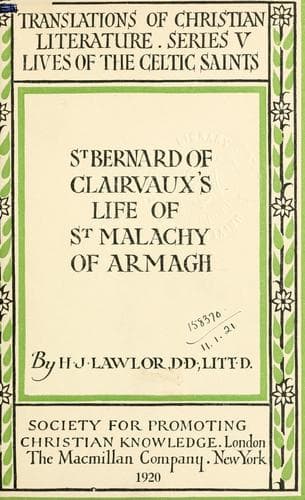
St. Bernard of Clairvaux's Life of St. Malachy of ArmaghBernard, of Clairvaux, Saint
History
St. Bernard of Clairvaux's Life of St. Malachy of Armagh
Bernard, of Clairvaux, Saint
Malachy, Saint, 1094?-1148
[496] This cannot be the true reason for Malachy's choice of Down
rather than Connor. If he had wished to go to Connor on his retirement
from Armagh he could have consecrated a bishop for Down. It is more
probable that his preference was due to his love for Bangor, where he
resided during his first episcopate, and where he probably resided
also when he was bishop of Down. But, however that may be, Bangor was
necessarily under his jurisdiction as bishop of Down; his connexion
with it would have been severed if he had assumed the oversight of the
new diocese of Connor.
[497] Isa. li. 9; Amos ix. 11.
[498] Cp. Cant. i. 15; iv. i.; v. 12.--St. Bernard himself is said to
have had "dove-like eyes" (_V.P._ v. 12); and the meaning of the
phrase is explained thus: "In his eyes there shone a certain angelic
_purity_ and a dove-like _simplicity_ (single-mindedness)" (_ibid._
iii. 1).
[499] Amos i. 13.
[500] Cp. § 44, p. 83.
[501] It has been commonly assumed that the house of this
convent--which obviously consisted of Augustinian canons (the only
order of regular clerics recognized at this period by the Roman
Church: see Conc. Lat. 1139, can. 9, Mansi xxi. 528)--was in
Downpatrick. It has accordingly been identified with a monastery which
in the Terrier of 1615 is described as "the monastery of the Irish,
hard by the Cathedral," and called "the church of the channons"
(Reeves, 43, 231). But it is not stated in the text to have been in
Down. It seems more likely to have been the monastery of Bangor, which
was destroyed in 1127 (§ 18), and must have been reconstituted about
this time. There is no indication in the _Life_ that Malachy resided
in Down, while there are several hints that Bangor was his
headquarters and that he was abbot of the community there as long as
he lived. (See p. 33, n. 1.) In other words Bangor was, in fact if not
in name, the see of the diocese of Ulaid, or Down. For this curious
anomaly we have a parallel in the diocese of Tír Eoghain, the see of
which for a long period was at Maghera, the bishop, the while, being
often styled bishop of Derry (_Irish Church Quarterly_, x. 225 ff.);
and for the bishop of a diocese serving as abbot of his cathedral
chapter of regular canons we may point to Carlisle (_Trans. of
Scottish Ecclesiological Society_, iii. 267 ff.), Louth (_L.A.J._ iv.
143 ff.) and Christ Church, Dublin (_ibid._ 145). That the canons of
Bangor were at an early period the bishop's chapter we have
independent evidence. For in 1244 the Pope gave judgement in a cause
which had been pending for some time between the prior and monks of
Down and the abbot and canons of Bangor, each of whom claimed that
their church was cathedral (Theiner, p. 42). This claim on behalf of
Bangor is easily explained if it was reckoned as the bishop's see in
the time of Malachy.
[502] 2 Cor. x. 4.
[503] Luke viii. 5.
[504] Matt. xxi. 23; Mark xi. 28.
[505] Acts viii. 6; John ii. 23.
[506] 2 Cor. iii. 17.
CHAPTER V
Public-domain text, read in full here on John Shaqi.
Reviews
Reviews
No reviews yet
Be the first to share your thoughts on this work.
Elsewhere in the archive
Join the Discussion
Join the discussion
Sign in to leave a comment or review.
Sign InorCreate an account