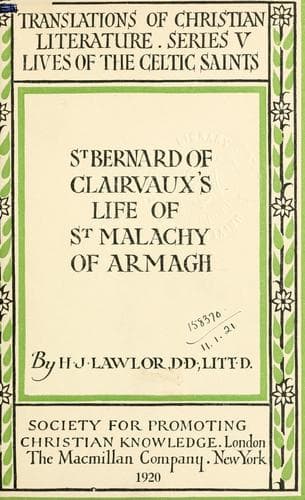
St. Bernard of Clairvaux's Life of St. Malachy of ArmaghBernard, of Clairvaux, Saint
History
St. Bernard of Clairvaux's Life of St. Malachy of Armagh
Bernard, of Clairvaux, Saint
Malachy, Saint, 1094?-1148
consecrated Malachy set out on his journey.
35. And when he had left Scotland[519] and reached York, a priest,
named Sycarus,[520] _steadfastly beholding him_[521] recognized him. For
though he had not seen his face before, because he _had the spirit of
prophecy_[522] he had received a revelation concerning him long ago. And
now without hesitation he pointed him out with his finger to those who
stood round him, saying, "_This is he of whom I had said_ that from
Ireland _there shall come_[523] a holy bishop who _knoweth the thoughts
of man_."[524] So the _lamp_ could not be hid _under a bushel_, for the
Holy Spirit who _lighted_ it[525] brought it forth by the mouth of
Sycarus. For also many secret things concerning the affairs of him and
his companions were told him by Sycarus, all of which he acknowledged to
be or to have been. But when the companions of Malachy went on to
inquire about their return, Sycarus immediately replied--and _the event
afterwards proved the truth of the saying_[526]--that evidently very few
of their number would return with the bishop. When they heard that they
imagined that he apprehended death: but God fulfilled it in another way;
for on his way back from the City he left some with us, and some in
other places, to learn the rule of life;[527] and so, _according to the
word_ of Sycarus,[528] he returned to his own country with very few
companions. So much concerning Sycarus.
36. In the same city of York he was visited by a man of noble rank
according to the standard of the world, Waltheof[529] by name, then
prior of the regular brothers at Kirkham,[530] but now a monk, and
father of the monks at Melrose, a monastery of our Order,[531] who
devoutly commended himself with humility to Malachy's prayers. And when
he noticed that the bishop had many companions and few horses--for
besides ministers[532] and other clerks he had with him five presbyters,
and only three horses--he offered him his own, on which he rode, saying
that he regretted only one thing, that it was a pack-horse[533] and a
rough animal to ride. And he added, "I would have given it more
willingly if it had been better; but, if you think it worth while, take
it with you, such as it is." "And I," replied the bishop, "accept it the
more willingly the more valueless you proclaim it, because nothing can
be of no value to me which so precious a will offers;" and, turning to
his companions, "Saddle this horse for me, for it is suitable for me,
and will suffice for a long time." This done, he mounts. And at first he
considered it rough, as it was, but afterwards, by a wonderful change,
he found that it suited him well and ambled pleasantly. And that there
might not _fall_ on _the ground_ any part of the word which he had
spoken,[534] till the ninth year, the year in which he died,[535] it did
not fail him, and became an excellent and very valuable palfrey.
And--that which made the miracle more evident to those that saw--from
Public-domain text, read in full here on John Shaqi.
Reviews
Reviews
No reviews yet
Be the first to share your thoughts on this work.
Elsewhere in the archive
Join the Discussion
Join the discussion
Sign in to leave a comment or review.
Sign InorCreate an account