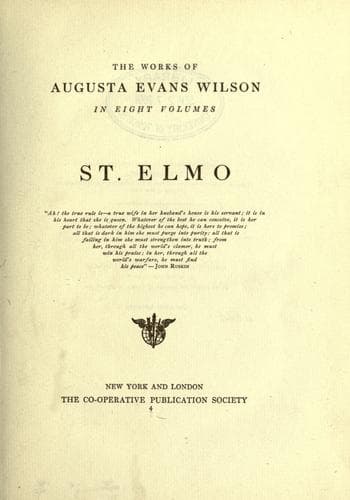
Alabama -- History -- Civil War, 1861-1865 -- Fiction; Domestic fiction; War stories
"Common sense! Oh, Gordon, dearie! how unreasonable you are! Why, you
have told me a thousand times that I had not a particle of common
sense, except on the subject of juleps; and how, then, in the name of
wonder, can you expect me to show any? I never pretended to be a great
shining genius like Edna, whose writings all the world is talking
about. I only want to be wise enough to understand you, dearie, and
make you happy. Gordon, don't you feel any better? What makes your face
so red?"
She went back to his chair, and leaned her lovely head close to his,
while an anxious expression filled her large blue eyes.
Gordon Leigh realized that his marriage was a terrible mistake, which
only death could rectify; but even in his wretchedness he was just,
blaming only himself--exonerating his wife. Had he not wooed the love
of which, already, he was weary? Having deceived her at the altar, was
there justification for his dropping the mask at the hearthstone? Nay,
the skeleton must be no rattling of skull and crossbones to freeze the
blood in the sweet laughing face of the trusting bird.
Now her clinging tenderness, her affectionate humility, upbraided him
as no harsh words could possibly have done. With a smothered sigh he
passed his arm around her, and drew her closer to his side.
"At least my little wife is wise enough to teach her husband to be
ashamed of his petulance."
"And quite wise enough, dear Gertrude, to make him very proud and
happy; for you ought to be able to say with the sweetest singer in all
merry England:
'But I look up and he looks down,
And thus our married eyes can meet;
Unclouded his, and clear of frown,
And gravely sweet.'"
As Edna glanced at the young wife and uttered these words, a mist
gathered in her own eyes, and collecting her sewing utensils she went
to her room to pack her trunk.
During her stay at the parsonage she had not attended service in the
church, because Mr. Hammond was lonely, and her Sabbaths were spent in
reading to him. But her old associates in the choir insisted that,
before she returned to New York, she should sing with them once more.
Thus far she had declined all invitations; but on the morning of the
last day of her visit, the organist called to say that a distinguished
divine, from a distant State, would fill Mr. Hammond's pulpit; and as
the best and leading soprano in the choir was disabled by severe cold,
and could not be present, he begged that Edna would take her place, and
sing a certain solo in the music which he had selected for an opening
piece. Mr. Hammond, who was pardonably proud of his choir, was anxious
that the stranger should be greeted and inspired by fine music, and
urged Edna's compliance with the request.
Reluctantly she consented, and for the first time Duty and Love seemed
to signal a truce, to shake hands over the preliminaries of a treaty
for peace.
Public-domain text, read in full here on John Shaqi.
Reviews
Reviews
No reviews yet
Be the first to share your thoughts on this work.
Elsewhere in the archive
Join the Discussion
Join the discussion
Sign in to leave a comment or review.
Sign InorCreate an account