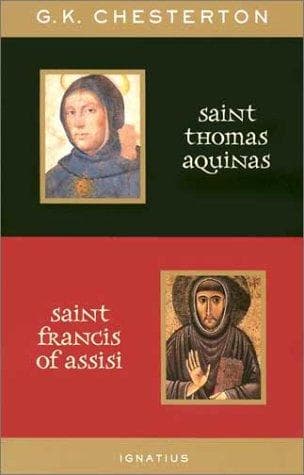
St. Francis of AssisiChesterton, G. K. (Gilbert Keith)
Religion
St. Francis of Assisi
Chesterton, G. K. (Gilbert Keith)
Francis, of Assisi, Saint, 1182-1226
Innocent III., the great Pope, according to Bonaventura, was walking on
the terrace of St. John Lateran, doubtless revolving the great political
questions which troubled his reign, when there appeared abruptly before
him a person in peasant costume whom he took to be some sort of
shepherd. He appears to have got rid of the shepherd with all convenient
speed; possibly he formed the opinion that the shepherd was mad. Anyhow
he thought no more about it until, says the great Franciscan biographer,
he dreamed that night a strange dream. He fancied that he saw the whole
huge ancient temple of St. John Lateran, on whose high terraces he had
walked so securely, leaning horribly and crooked against the sky as if
all its domes and turrets were stooping before an earthquake. Then he
looked again and saw that a human figure was holding it up like a living
caryatid; and the figure was that of the ragged shepherd or peasant from
whom he had turned away on the terrace. Whether this be a fact or a
figure it is a very true figure of the abrupt simplicity with which
Francis won the attention and the favour of Rome. His first friend seems
to have been the Cardinal Giovanni di San Paolo who pleaded for the
Franciscan idea before a conclave of Cardinals summoned for the purpose.
It is interesting to note that the doubts thrown upon it seem to have
been chiefly doubts about whether the rule was not too hard for
humanity, for the Catholic Church is always on the watch against
excessive asceticism and its evils. Probably they meant, especially when
they said it was unduly hard, that it was unduly dangerous. For a
certain element that can only be called danger is what marks the
innovation as compared with older institutions of the kind. In one sense
indeed the friar was almost the opposite of the monk. The value of the
old monasticism had been that there was not only an ethical but an
economic repose. Out of that repose had come the works for which the
world will never be sufficiently grateful, the preservation of the
classics, the beginning of the Gothic, the schemes of science and
philosophies, the illuminated manuscripts and the coloured glass. The
whole point of a monk was that his economic affairs were settled for
good; he knew where he would get his supper, though it was a very plain
supper. But the whole point of a friar was that he did not know where he
would get his supper. There was always a possibility that he might get
no supper. There was an element of what would be called romance, as of
the gipsy or adventurer. But there was also an element of potential
tragedy, as of the tramp or the casual labourer. So the Cardinals of the
thirteenth century were filled with compassion, seeing a few men
entering of their own free will that estate to which the poor of the
twentieth century are daily driven by cold coercion and moved on by the
police.
Public-domain text, read in full here on John Shaqi.
Reviews
Reviews
No reviews yet
Be the first to share your thoughts on this work.
Elsewhere in the archive
Join the Discussion
Join the discussion
Sign in to leave a comment or review.
Sign InorCreate an account