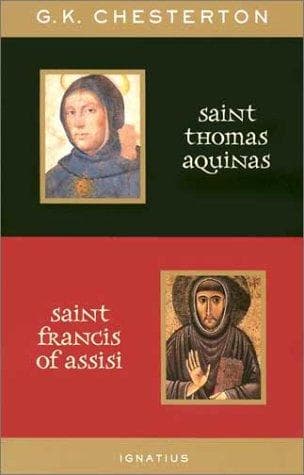
St. Francis of AssisiChesterton, G. K. (Gilbert Keith)
Religion
St. Francis of Assisi
Chesterton, G. K. (Gilbert Keith)
Francis, of Assisi, Saint, 1182-1226
As I shall suggest in a moment, there is one sense in which we can for
practical purposes distinguish between probable and improbable things in
such a story. It is not so much a question of cosmic criticism about the
nature of the event as of literary criticism about the nature of the
story. Some stories are told much more seriously than others. But apart
from this, I shall not attempt here any definite differentiation between
them. I shall not do so for a practical reason affecting the utility of
the proceeding; I mean the fact that in a practical sense the whole of
this matter is again in the melting pot, from which many things may
emerge moulded into what rationalism would have called monsters. The
fixed points of faith and philosophy do indeed remain always the same.
Whether a man believes that fire in one case could fail to burn, depends
on why he thinks it generally does burn. If it burns nine sticks out of
ten because it is its nature or doom to do so, then it will burn the
tenth stick as well. If it burns nine sticks because it is the will of
God that it should, then it might be the will of God that the tenth
should be unburned. Nobody can get behind that fundamental difference
about the reason of things; and it is as rational for a theist to
believe in miracles as for an atheist to disbelieve in them. In other
words there is only one intelligent reason why a man does not believe in
miracles and that is that he does believe in materialism. But these
fixed points of faith and philosophy are things for a theoretical work
and have no particular place here. And in the matter of history and
biography, which have their place here, nothing is fixed at all. The
world is in a welter of the possible and impossible, and nobody knows
what will be the next scientific hypothesis to support some ancient
superstition. Three quarters of the miracles attributed to St. Francis
would already be explained by psychologists, not indeed as a Catholic
explains them, but as a materialist must necessarily refuse to explain
them. There is one whole department of the miracles of St. Francis; the
miracles of healing. What is the good of a superior sceptic throwing
them away as unthinkable, at the moment when faith-healing is already a
big booming Yankee business like Barnum's Show? There is another whole
department analogous to the tales of Christ "perceiving men's thoughts."
What is the use of censoring them and blacking them out because they are
marked "miracles," when thought-reading is already a parlour game like
musical chairs? There is another whole department, to be studied
separately if such scientific study were possible, of the well-attested
wonders worked from his relics and fragmentary possessions. What is the
use of dismissing all that as inconceivable, when even these common
psychical parlour tricks turn perpetually upon touching some familiar
object or holding in the hand some personal possession? I do not
Public-domain text, read in full here on John Shaqi.
Reviews
Reviews
No reviews yet
Be the first to share your thoughts on this work.
Elsewhere in the archive
Join the Discussion
Join the discussion
Sign in to leave a comment or review.
Sign InorCreate an account