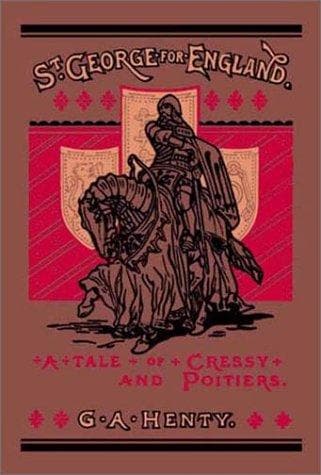
St. George for EnglandHenty, G. A. (George Alfred)
History
St. George for England
Henty, G. A. (George Alfred)
Great Britain -- History -- Edward III, 1327-1377 -- Fiction
The knight stood for a moment astounded. He was aware that the fact that
he had had some share in the outrage was known, and was not surprised
that his cousin was acquainted with the secret; but that she should know
all the details with which but one besides himself was, as he believed,
acquainted, completely stupefied him. He rapidly, however, recovered
himself.
“I recall now,” he said scornfully, “the evidence which was given
before the justices by some ragged city boy, to the effect that he had
overheard a few words of a conversation between some ruffian over in the
Lambeth marshes, and an unknown person; but it is new to me indeed that
there was any suspicion that I was the person alluded to, still less
that a lady of my own family, in whose affection I believed, should
credit so monstrous an accusation.”
“I would that I could discredit it, Sir James,” Dame Vernon said sadly;
“but the proofs were too strong for me. Much more of your conversation
than was narrated in court was overheard, and it was at my request that
the ragged boy, as you call him, kept silence.”
“And is it possible,” the knight asked indignantly, “that you believed
the word of a fellow like this to the detriment to your kinsman? Why, in
any court of law the word of such a one as opposed to that of a knight
and gentleman of honour would not be taken for a moment.”
“You are mistaken, sir,” Dame Vernon said haughtily. “You may remember,
in the first place, that the lad who overheard this conversation risked
his life to save me and my daughter from the consequences of the attack
which he heard planned; in the second place, he was no ragged lad,
but the apprentice of a well-known citizen; thirdly, and this is of
importance, since he has recognized you since your return, and is ready
should I give him the word, to denounce you. He is no mere apprentice
boy, but is of gentle blood, seeing that he is the son of Sir Roland
Somers, the former possessor of the lands which I hold, and that he is
in high favour with the good knight Sir Walter Manny, whose esquire he
now is, and under whom he distinguished himself in the wars in France,
and is, as Sir Walter assured me, certain to win his spurs ere long.
Thus you see his bare word would be of equal value to your own, beside
the fact that his evidence does not rest upon mere assertion; but that
the man in the hut promised to do what you actually performed, namely,
to delay me at Richmond, and to wrap me in a white cloak in order that I
might be recognized by the river pirates.”
Sir James was silent. In truth, as he saw, the evidence was
overwhelmingly strong against him. After a while he stammered out, “I
cannot deny that I was the man in question; but I swear to you that
this boy was mistaken, and that the scoundrel acted altogether beyond my
instructions, which were simply that he should board the boat and carry
you and your daughter away to a safe place.”
Public-domain text, read in full here on John Shaqi.
Reviews
Reviews
No reviews yet
Be the first to share your thoughts on this work.
Elsewhere in the archive
Join the Discussion
Join the discussion
Sign in to leave a comment or review.
Sign InorCreate an account