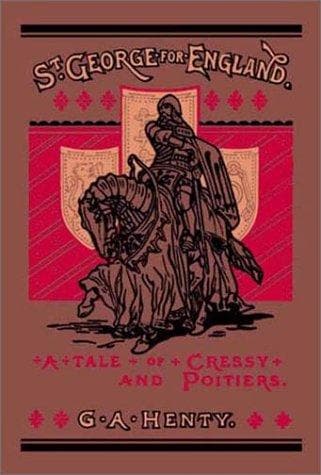
St. George for EnglandHenty, G. A. (George Alfred)
History
St. George for England
Henty, G. A. (George Alfred)
Great Britain -- History -- Edward III, 1327-1377 -- Fiction
Walter did not like taking a gift so valuable, for his apprenticeship as
an armourer had taught him the extreme rarity and costliness of so fine
a piece of work. Geoffrey, however, would not hear of his refusal, and
insisted on his then and there taking off his doublet and putting it
on. It fitted closely to the body, descending just below the hips, and
coming well up on the neck, while the arms extended to the wrists.
“There!” the smith said with delight. “Now you are safe against sword or
dagger, save for a sweeping blow at the head, and that your sword can
be trusted to guard. Never take it off, Walter, save when you sleep; and
except when in your own bed, at Sir Walter Manny's, I should advise
you to wear it even at night. The weight is nothing, and it will not
incommode you. So long as this caitiff knight lives, your life will not
be safe. When he is dead you may hang up the shirt of mail with a light
heart.”
CHAPTER XII: JACOB VAN ARTEVELDE
King Edward found no difficulty in awakening the war spirit of England
anew, for the King of France, in an act of infamous treachery, in
despite of the solemn terms of the treaty, excited against himself the
indignation not only of England but of all Europe. Oliver de Clisson,
with fourteen other nobles of Brittany and Normandy, were arrested by
his order, taken to Paris, and without form of trial there decapitated.
This act of treachery and injustice aroused disgust and shame among the
French nobles, and murmurs and discontent spread throughout the whole
country.
In Brittany numbers of the nobles fell off from the cause of Charles of
Blois, and King Edward hastened his preparations to avenge the butchery
of the adherents of the house of Montford. Phillip, however, in defiance
of the murmurs of his own subjects, of the indignant remonstrances
of Edward, and even those of the pope, who was devoted to his cause,
continued the course he had begun, and a number of other nobles were
seized and executed. Godfrey of Harcourt alone, warned by the fate of
his companions, refused to obey the summons of the king to repair to
Paris, and fled to Brabant. His property in France was at once seized by
Phillip; and Godfrey, finding that the Duke of Brabant would be unable
to shield him from Phillip's vengeance, fled to the English court, and
did homage to Edward.
On the 24th of April, 1345, Edward determined no longer to allow Phillip
to continue to benefit by his constant violations of the truce, and
accordingly sent a defiance to the King of France.
De Montford, who had just succeeded in escaping from his prison in
Paris, arrived at this moment in England, and shortly afterwards set
sail with a small army under the command of the Earl of Northampton for
Britanny, while the Earl of Derby took his departure with a larger force
for the defence of Guienne.
Public-domain text, read in full here on John Shaqi.
Reviews
Reviews
No reviews yet
Be the first to share your thoughts on this work.
Elsewhere in the archive
Join the Discussion
Join the discussion
Sign in to leave a comment or review.
Sign InorCreate an account