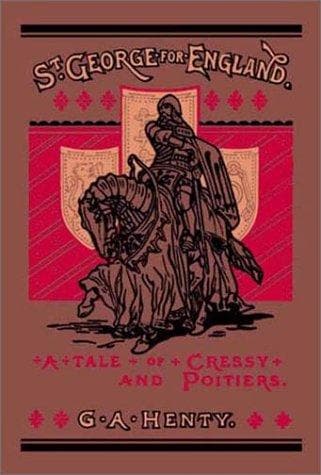
St. George for EnglandHenty, G. A. (George Alfred)
History
St. George for England
Henty, G. A. (George Alfred)
Great Britain -- History -- Edward III, 1327-1377 -- Fiction
Edward at once called the prisoners belonging to that part of the
country before him, and promised to any one who would tell him where
the ford lay his freedom and that of twenty of his companions. A peasant
called Gobin Agase stepped forward and offered to show the ford, where
at low tide twelve men could cross abreast. It was, he said, called “La
Blanche Tache”.
Edward left Oisemont at midnight and reached the ford at daylight. The
river, however, was full and the army had to wait impatiently for low
tide. When they arrived there no enemy was to be seen on the opposite
bank, but before the water fell sufficiently for a passage to be
attempted, Sir Godemar du Fay with 12,000 men, sent by King Phillip, who
was aware of the existence of the ford, arrived on the opposite side.
The enterprise was a difficult one indeed, for the water, even at low
tide, is deep. Godemar du Fay, however, threw away part of his advantage
by advancing into the stream. The English archers lined the banks, and
poured showers of arrows into the ranks of the enemy, while the Genoese
bowmen on their side were able to give comparatively little assistance
to the French.
King Edward shouted to his knights, “Let those who love me follow me,”
and spurred his horse into the water. Behind him followed his most
valiant knights, and Walter riding close to the Prince of Wales was one
of the foremost.
The French resisted valiantly and a desperate battle took place on the
narrow ford, but the impetuosity of the English prevailed, and step
by step they drove the French back to the other side of the river. The
whole army poured after their leaders, and the French were soon entirely
routed and fled, leaving two thousand men-at-arms dead on the field.
King Edward, having now freed himself from the difficulties which had
encompassed him on the other side of the river, prepared to choose a
ground to give battle to the whole French army.
Louis had advanced slowly, feeling confident that the English would be
unable to cross the river, and that he should catch them hemmed in by
it. His mortification and surprise on finding, when he approached La
Blanche Tache, that twelve thousand men had been insufficient to hold
a ford by which but twelve could cross abreast, and that his enemy had
escaped from his grasp, were great. The tide had now risen again, and he
was obliged to march on to Abbeville and cross the river there.
King Edward now advanced into the Forest of Cressy.
Hugh de le Spencer, with a considerable force, was despatched to Crotoy,
which he carried by assault after a severe conflict, in which four
thousand of the French men-at-arms were slain. The capture of this city
removed all danger of want from the army, for large stores of wine and
meal were found there, and Sir Hugh at once sent off a supply to the
tired army in the field.
Public-domain text, read in full here on John Shaqi.
Reviews
Reviews
No reviews yet
Be the first to share your thoughts on this work.
Elsewhere in the archive
Join the Discussion
Join the discussion
Sign in to leave a comment or review.
Sign InorCreate an account