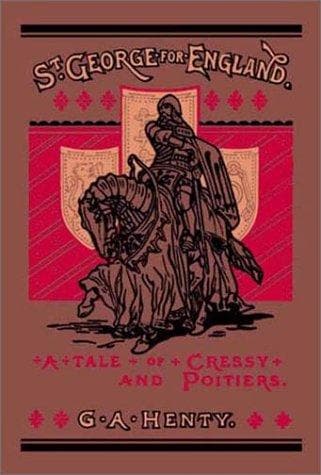
St. George for EnglandHenty, G. A. (George Alfred)
History
St. George for England
Henty, G. A. (George Alfred)
Great Britain -- History -- Edward III, 1327-1377 -- Fiction
“It would be useless, Ralph. We may have suspicion of the man from whom
the blow came, but have no manner of proof. It might have been done
by any ruffian camp-follower who struck the blow only with the hope of
carrying off my chain and purse. The camp swarms with such fellows, and
we have no clue which could lead to his detection, unless,” he added,
stooping and picking a piece of steel which lay at his feet, “this
broken dagger may some day furnish us with one. No; we will say nought
about it. Sir James Carnegie is not now in camp, having left a week
since on business in England. We exchange no words when we meet, but I
heard that he had been called away. Fortunately the young prince likes
him not, and I therefore have seldom occasion to meet him. I have no
doubt that he credits me with the disfavour in which he is held by the
prince; but I have never even mentioned his name before him, and the
prince's misliking is but the feeling which a noble and generous heart
has, as though by instinct, against one who is false and treacherous.
At the same time we must grant that this traitor knight is a bold and
fearless man-at-arms; he fought well at La Blanche Tache and Cressy,
and he is much liked and trusted by my lord of Northampton, in whose
following he mostly rides; 'tis a pity that one so brave should have so
foul and treacherous a heart. Here we are at my hut, and you can sleep
soundly tonight, Ralph, for there is little fear that the fellow, who
has failed tonight, will repeat his attempt for some time. He thinks,
no doubt, that he has killed me, for with a blow so strongly struck
he would scarcely have felt the snapping of the weapon, and is likely
enough already on board one of the ships which ply to and fro from
England on his way to acquaint his employer that I am removed from his
path.”
The next morning Walter mentioned to the Black Prince the venture which
had befallen him, and the narrow escape he had had of his life. The
prince was extremely exasperated, and gave orders that an inquisition
should be made through the camp, and that all men found there not being
able to give a good account of themselves as having reasonable and
lawful calling there should be forthwith put on board ship and sent to
England. He questioned Walter closely whether he deemed that the attack
was for the purpose of plunder only, or whether he had any reason to
believe that he had private enemies.
“There is a knight who is evilly disposed toward me, your highness,”
Walter said; “but seeing that I have no proof whatever that he had a
hand in this affair, however strongly I may suspect it, I would fain,
with your leave, avoid mentioning his name.”
“But think you that there is any knight in this camp capable of so foul
an action?”
Public-domain text, read in full here on John Shaqi.
Reviews
Reviews
No reviews yet
Be the first to share your thoughts on this work.
Elsewhere in the archive
Join the Discussion
Join the discussion
Sign in to leave a comment or review.
Sign InorCreate an account