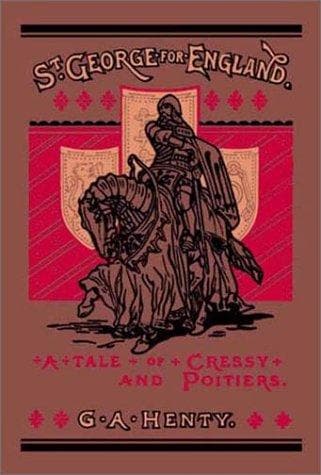
St. George for EnglandHenty, G. A. (George Alfred)
History
St. George for England
Henty, G. A. (George Alfred)
Great Britain -- History -- Edward III, 1327-1377 -- Fiction
Presently a movement could be seen among the stones, and then almost
simultaneously two apertures appeared. The chamber into which the
openings were made was a large one, being used as the common room of the
garrison. Here twenty archers, and the remaining men-at-arms--of whom
nearly one-half had fallen in the defence of the breach--were gathered,
and the instant the orifices appeared the archers began to send their
arrows through them. Then Walter ascended to another chamber, and
ordered the trumpeter to sound a parley.
The sound was repeated by the assailants' trumpeter.
“Who commands the force?” Walter asked.
“I, Guy, Count of Evreux.”
“I am Sir Walter Somers,” the young knight continued. “I wish to ask
terms for the garrison.
“You must surrender unconditionally,” the count replied from the
courtyard. “In ten minutes we shall have completely pierced your walls,
and you will be at our mercy.”
“You may pierce our walls,” Walter replied, “but it will cost you many
lives before you force your way in; we will defend the hold from floor
to floor, and you know how desperate men can fight. It will cost you
scores of lives before you win your way to the summit of this keep; but
if I have your knightly word that the lives of all within these walls
shall be spared, then will I open the door and lay down our arms.”
A consultation took place between the leaders below. There was truth
in Walter's words that very many lives would be sacrificed before the
resistance of so gallant a garrison could be overcome. Every minute was
of importance, for it was possible that at any moment aid might arrive
from Calais, and that the table would be turned upon the besiegers.
Therefore, after a short parley among themselves, the count replied:
“You have fought as a gallant knight and gentleman, Sir Walter Somers,
and have wrought grievous harm upon my leading. I should grieve that so
brave a knight should lose his life in a useless resistance. Therefore
I agree to your terms, and swear upon my knightly honour that upon your
surrendering yourselves prisoners of war, the lives of all within these
walls shall be spared.”
Walter at once gave the order. The stones were removed and the door
thrown open, and leading his men Walter descended the steps into the
courtyard, which was now illuminated with torches, and handed his sword
to the Count of Evreux.
“You promised me, count,” a tall knight standing by his side said,
“that if he were taken alive, the commander of this castle should be my
prisoner.”
“I did so, Sir Phillip Holbeaut. When you proposed this adventure to
me, and offered to place your following at my command, I agreed to the
request you made me; but mind,” he said sternly, “my knightly word
has been given for his safety. See that he receives fair and gentle
treatment at your hand. I would not that aught should befall so brave a
knight.”
Public-domain text, read in full here on John Shaqi.
Reviews
Reviews
No reviews yet
Be the first to share your thoughts on this work.
Elsewhere in the archive
Join the Discussion
Join the discussion
Sign in to leave a comment or review.
Sign InorCreate an account