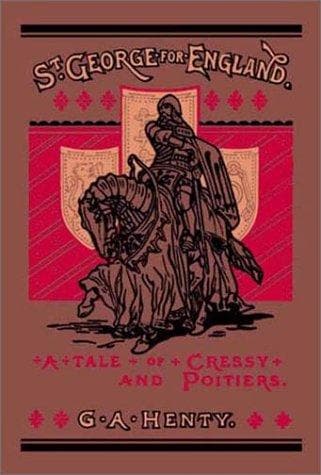
St. George for EnglandHenty, G. A. (George Alfred)
History
St. George for England
Henty, G. A. (George Alfred)
Great Britain -- History -- Edward III, 1327-1377 -- Fiction
No satisfactory reasons ever have been assigned for this extraordinary
step on the part of the French king. He had been for months engaged in
collecting a huge army, and he had now an opportunity of fighting the
English in a fair field with a force four times as great as their own.
The only means indeed of accounting for his conduct is by supposing him
affected by temporary aberration of mind, which many other facts in his
history render not improbable. The fits of rage so frequently recorded
of him border upon madness, and a number of strange actions highly
detrimental to his own interests which he committed can only be
accounted for as the acts of a diseased mind. This view has been to some
extent confirmed by the fact that less than half a century afterwards
insanity declared itself among his descendants.
A few hours after the departure of the French the French standard was
lowered on the walls of Calais, and news was brought to Edward that
the governor was upon the battlements and desired to speak with some
officers of the besieging army. Sir Walter Manny and Lord Bisset were
sent to confer with him, and found that his object was to obtain the
best terms he could. The English knights, knowing the determination of
the king on the subject, were forced to tell him that no possibility
existed of conditions being granted, but that the king demanded their
unconditional surrender, reserving to himself entirely the right whom to
pardon and whom to put to death.
The governor remonstrated on the severe terms, and said that rather
than submit to them he and his soldiers would sally out and die sword in
hand. Sir Walter Manny found the king inexorable. The strict laws of war
in those days justified the barbarous practise of putting to death the
garrison of a town captured under such circumstances. Calais had been
for many years a nest of pirates, and vessels issuing from its port had
been a scourge to the commerce of England and Flanders, and the king was
fully determined to punish it severely. Sir Walter Manny interceded long
and boldly, and represented to the king that none of his soldiers would
willingly defend a town on his behalf from the day on which he put to
death the people of Calais, as beyond doubt the French would retaliate
in every succeeding siege. The other nobles and knights joined their
entreaties to those of Sir Walter Manny, and the king finally consented
to yield in some degree. He demanded that six of the most notable
burghers of the town, with bare heads and feet, and with ropes about
their necks and the keys of the fortress in their hands, should deliver
themselves up for execution. On these conditions he agreed to spare the
rest. With these terms Sir Walter Manny returned to Sir John of Vienne.
Public-domain text, read in full here on John Shaqi.
Reviews
Reviews
No reviews yet
Be the first to share your thoughts on this work.
Elsewhere in the archive
Join the Discussion
Join the discussion
Sign in to leave a comment or review.
Sign InorCreate an account